What Is a Modern Data Stack? Components, Benefits & Best Tools
The modern data stack (MDS) is a set of cloud-native modular tools that can collect, store, transform, and analyze business data.
Data science is changing day by day, and we have to move along with it. The traditional data stack used to be enough for that time, but not anymore. New challenges in the industry require modern solutions.
If you are a data scientist or a data engineer, read this article to learn about the modern data stack. This article will explore everything from its components to its benefits.
Let’s explore!
What is a Data Stack?
In simple words, a data stack is a set of tools or technologies that are used to organise, clean, store, and transform data.
These are some of the best tools that data engineers or data analysts use to extract and collect data in a single place. Without any hassle, they can transform raw data into something that creates value for them. Then store it and analyse it as they see fit.
There is no point in having a vast amount of data if you don’t have competent tools to publish and analyse it.
What is the Modern Data Stack?
People often use the terms data stack and modern data stack as synonyms. However, there is a clear distinction between the two.
The modern data stack uses innovative or cloud-based data warehouses instead of on-premises.
So, the essence is that the modern data stack is stored in the cloud. That is why they are more accessible and scalable compared to on-premises data warehouses.
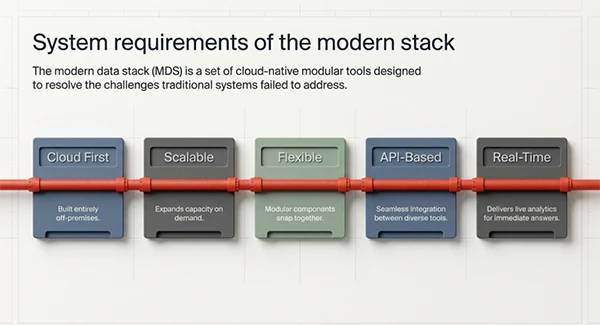
Modern data stacks address the data challenges traditional data stacks failed to resolve.
Key Features of Modern Data Stacks
- Scalability
- Flexibility
- Cloud First
- API-based
- Real-time analytics
Key Components of the Modern Data Stack
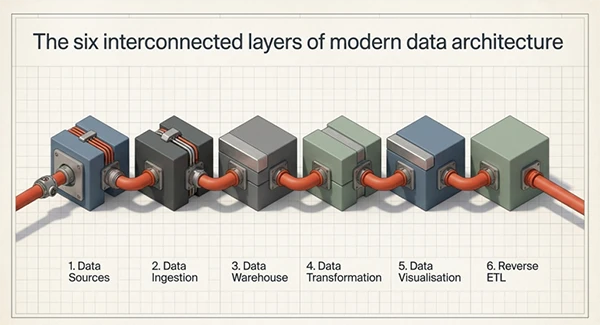
These modern tools have a layered architecture. Each of these layers in the modern data stack serves a distinct purpose.
This modular approach makes it a great choice for startups, mid-size companies, and enterprises. With the help of modern data stacks, companies can easily scale their data operations without investing heavily in engineering.
Let’s check out the key components of a modern data stack.
1. Data Sources
First and foremost, you need data sources to get data from. Most often, this is a third-party tool that can manage operations and generate raw data from CRMs, ad platforms, web apps, files, and databases.
2. Data Ingestion (ELT)
This component moves data from the source to a data warehouse with no effort and no-code connectors. The abundance of modern data ingestion tools makes it easier to collect data.
3. Data Warehouse
It is a system that centralizes all extracted data for further processing and analysis at scale. BigQuery and Snowflake are a couple of examples of data warehouses.
4. Data Transformation
This is the component or process where raw data is converted into user friendly mode by changing its format and structure.
5. Data Visualization
Data Visualization is the stage where you gather insights from the accumulated data. This data will help you make informed decisions based on analysis.
6. Reverse ETL
The last component of a modern data stack is a reverse ETL. This is a process where all this processed data is sent back to operational tools to make it useful.
Benefits of a Modern Data Stack
Today, businesses generate more data than ever before. Ever since the introduction of AI, new startups are generating tons of data.
Without the right technology, gathering this kind of data is of no use. It remains scattered across multiple systems. That’s where the modern data stack comes in.
Adopting it yields many benefits for businesses. Here is the list.
- Faster Decision Making – Of course, modern businesses need answers quickly, and the modern data stack helps with real-time dashboards.
- Cost Efficiency – You have to agree that on-premises solutions are more costly than cloud-based solutions. So, it makes sense for startups and mid-size companies to invest in a cloud-based data stack.
- Improved Data Quality – All these modern data tools clean and organize information before it even reaches reporting tools. So, it’s obvious that the data quality will improve with reduced errors.
- Wide Adoption – All modern data stack solutions in 2026 are designed to streamline data workflows. So, even if you are not cut from the same cloth as a data scientist, you can try these tools without hesitation.
Modern Data Stack vs. Legacy Data Stack
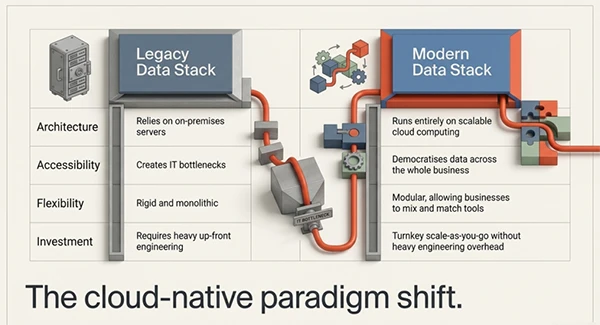
There is a stark contrast between the two. Understanding the difference will clarify a few things.
- Architecture – The modern stack runs on cloud computing, whereas a legacy stack depends on servers. Most modern stacks are more scalable, flexible, and efficient than their counterparts.
- Accessibility – Legacy systems may create IT bottlenecks when the organization expands. In contrast, the modern stack democratizes the data across the whole business.
- Flexibility – Modern stacks allow businesses to mix and match tools based on pricing and more.
Best Modern Data Stack Tools
As we’ve seen in the components section, there are many things to juggle in a modern stack. Here we’ve listed no-nonsense best cloud-based ETL tools for modern data stacks in 2026.
Check them out.
- Fivetran – This modern stack solution offers fully managed pipelines so that you can completely automate the data integration process. With this, you can get high-quality and reliable data that powers your architecture continuously.
- Snowflake – Snowflake is a cloud-based modern data warehouse that can help businesses scale storage and compute according to their needs.
- Google BigQuery – If you are looking for a serverless, highly scalable, and cost-efficient cloud data warehouse, Google BigQuery could be an excellent choice.
Conclusion
To conclude, we can only say that there is no such thing as an ideal modern data stack. The needs of every company are different; they use different tools to solve different sets of problems.
From this, you may guess that the tools will differ from company to company. However, the individual layers that make up a modern data stack remain the same. Technologies keep evolving year on year, and new tools keep coming to the market.
FAQs
What is a Modern Data Stack?
A modern data stack is a cloud-native set of technologies and tools that can collect, store, transform, and analyze business data.
What are the main layers of a Big Data Stack?
Data sources, data ingestion, data storage, data transformation, data warehouse, and reverse ETL are the main layers of a big data stack.
Which tools are commonly used in a modern data stack?
The most popular modern data stack tools are Snowflake, Databricks, Apache Spark, Apache Kafka, dbt, Airflow, Power BI, Tableau, Google BigQuery, and Amazon Redshift.
Sources:
- What is the modern data stack? – IBM
- What is a Modern Data Stack? – MongoDB