What Is Data Science? Definition, Process, Applications & Solutions
Raw data is useless until it can be understood in the proper way, and many business decisions are based on data today. Data science is a field that uses concepts of science to automate the process with insight algorithms and extracts and understands knowledge from unstructured data.
We will get into the definition of data science, the process, its main components, its applications in the industry, and the most popular tools in this blog. So, let’s get into it!
What is Data Science?
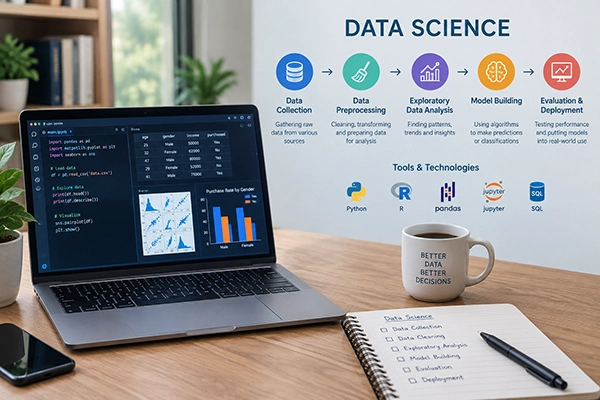
Data science is a field that focuses on gathering, processing, and interpreting data so we can find information and take informed steps forward. It comes from a mix of various disciplines like mathematics, statistics, computer science, and artificial intelligence. It can work with both structured data, such as customer records, and unstructured data, like text and images.
For example, an e-commerce business can use data science methods to study how its customers use the website, which pages they spend more time on, and how they shop. This helps to predict the results based on the available data on customer behavior.
So, you can simply say that data science is turning raw data into insights that help solve problems and prompt action.
How Does Data Science Work?
The data science process is not always completely linear. When teams find data quality issues, new patterns, or solutions to the original questions, they are able to backtrack to previous stages.
The following are the common steps involved in the data science process.
1. Data Collection
The first step is to get the necessary data to start working on, and this data can come from:
- Databases and business applications.
- Websites and mobile applications.
- APIs
- Customer transactions
- Sensors and IoT devices
- Surveys and forms
- Social media platforms
- A machine and system log will be created.
- Public datasets
The goal is not to collect as much information as you can. The data should be relevant, reliable, and appropriate for the problem being investigated.
2. Preparing and Cleaning Data
When you gather data, you can notice that the raw version is available for analysis, but it can be inaccurate, incomplete, or duplicated.
Data scientists and engineers can therefore:
- Remove duplicate records
- Handle missing values
- Correct inconsistent formats
- Identify outliers
- Discuss what they have learned from various sources.
- Transform variables
- Standardize datasets
- Create features for machine learning models.
Data preparation is crucial because low-quality data can result in inaccurate analysis and predictions.
3. Data Analysis
After preparing the data, data scientists dig into the data and look for patterns and meaning.
Summarizing, distribution, correlation, comparison, and visualization are all aspects of exploratory data analysis (EDA).
In this case, a business that is studying churn might find that customers who keep having issues with the service are more likely to cancel their services. These types of results could lead the team to look for relevant parameters to use for prediction modelling.
4. Modeling and Machine Learning
A data scientist can solve the problem with some sort of statistical techniques or machine learning algorithm.
A model could be used to:
- Predict future sales
- Data mining for strategy
- Identify potentially fraudulent transactions
- Segment customers
- Forecast demand
- Detect unusual activity
- Recommend products
- Predict the probability of an event.
There is a difference between machine learning and data science, and machine learning is an important aspect of modern data science. While it is a vital part, the field encompasses many other tasks that need to be done correctly to complete the process.
5. Interpretation and Communication
Without understanding and usage by others, a model’s output is of little value.
Data scientists share their insights in reports, dashboards, charts, presentations, and other data visualizations.
They may present a finding to stakeholders rather than a complex output from the model; for example, a finding is a piece of information that a data scientist sees as important.
The number of service problems a customer has in their first 90 days is predictive of customer churn.
This will help decision makers understand and act on the insight.
6. Deployment and Monitoring
In projects that result in operational models, the work does not have to stop after the model is made.
Once a model is deployed, it might be required to be integrated into an application or a business process and monitored afterwards; this is key, as market conditions, customer behavior, and more may evolve over time.
Monitoring and retraining can be used to ensure that the data science solution continues to be beneficial and reliable.
Check Out: 10 Best Cloud Data Warehouse Solutions in 2026: Platforms and Features
Key Components of Data Science
Data science is an interdisciplinary field. Data can be transformed into meaningful results by a number of areas.
Mathematics and Statistics
Data scientists can use statistics to learn about distribution, relationships, uncertainty, probability, and significance. Optimization and machine learning are built on many of the foundations provided by mathematics.
Programming
Data scientists collect data and mold it using programming. The two most popular programming languages in data science are Python and R.
Data Engineering
Reliable access to data is essential to data science. Data engineering helps to create pipelines and collect, move, store, and process data.
Machine Learning and AI
ML enables systems to understand patterns in data and make accurate predictions and classifications. These capabilities can be expanded to other domains like language processing, image analysis, recommendation systems, and automation with the help of AI techniques.
Data Visualization
Visualization is all about viewing and understanding the information. This process incorporates charts and dashboards to find patterns and tell the story to non-technical users.
Domain Knowledge
Technical skills do not equal success. To be a data scientist, you must know the business or industry in which a problem occurs. For instance, a healthcare model will have different requirements than a retail demand model.
Communication
Data scientists need to understand the findings and turn them into actionable advice. Effective communication promotes the idea that insights lead to action.
What is the Importance of Data Science?
As organizations primarily work online, data is readily available now; however, having raw data does not translate into actionable steps if you can not understand it.
And that is where data science helps to convert this information into usable knowledge.
It offers a number of advantages, such as:
- Improved Decision Making: With proper data, you can take the next step without any hits and error or assumptions.
- Predictive Insights: When the data is processed, it predicts demand, customer behavior, risk, and other outcomes.
- Improved Efficiency: Data science can help to identify gaps and automate the process.
- Personalization: It can narrow down the data and customize products, services, content, and recommendations for each individual user.
- Risk Management: The data can help predict risks and gaps earlier to work on.
- Better use of resources: Companies can efficiently use their resources and reduce waste.
The importance of data science ultimately is to provide valuable insights from the sea of data.
Applications of Data Science in Various Industries
Data science is utilized across a wide spectrum of industries. As organizations acquire more data and advance their analytical capabilities, the potential uses of data science across the various sectors are growing.
1. Healthcare
Data science can be applied to patient records, medical images, treatment outcomes, and other data to give healthcare organizations insights into patient information.
Applications can include:
- Predicting patient risks.
- Recognition of possible health irregularities.
- Supporting medical research.
- Personalizing treatment strategies.
- Forecasting hospital demand.
- Improving resource allocation.
Data science can also facilitate healthcare organizations in finding patterns in big data that would be hard to observe manually.
2. Finance and Banking
In the finance industry, data science is heavily used in applications such as handling large amounts of transactions and customer data.
Common uses include:
- Fraud detection
- Credit risk assessment
- Customer segmentation
- Risk modeling
- Financial forecasting
- Algorithmic trading
- Personalized financial services
For example, if a customer’s transactions normally occur at certain times but suddenly begin happening at different times, the fraud detection system can detect this change and alert the company.
Also Read: What Is a Modern Data Stack? Components, Benefits & Best Tools
3. Retail and E-commerce
Data science can be leveraged by retailers to gain insight into their customers and help them run their businesses more efficiently.
Applications include:
- Product recommendations
- Demand forecasting, customer segmentation, inventory optimization
- Price analysis
- Churn prediction
- Personalised promotions
A common example is the recommendation system. Based on browsing history, purchases, interactions with products, or other signals, businesses can make predictions about which products may be of interest to a customer.
4. Manufacturing
Production data, equipment readings, sensor data, and historical maintenance records can be used by manufacturers to enhance operations.
Data science can aid:
- Predictive maintenance
- Quality control
- Production optimization
- Supply chain forecasting
- Equipment monitoring
- Defect detection
With predictive maintenance, for instance, it is possible to recognize indications that suggest the equipment is likely to break down before it actually does.
5. Marketing
Data science is a tool that marketing teams use to gain a better understanding of audiences and to assess marketing campaigns.
Application include:
- Customer segmentation
- Campaign optimization
- Lead scoring
- Sentiment analysis
- Accurate estimation of the value of the customer during their lifetime.
- Churn prediction
- Content personalization
An understanding of customer activity on each channel enables better marketing targeting and allows organizations to quantify the effectiveness of their marketing efforts.
What are Data Science Solutions?
Data science solutions are a set of data science methods and technologies that solve a real-world problem in a business or organization.
A solution is not only about data and analytical methods, but it’s also about technology and business goals, and it ultimately generates a quantifiable result rather than just a technical exercise.
Some solutions to data science problems are:
- Predictive Analysis: The prediction of future events or behaviors with real-time analytics.
- Recommendation Systems: It is about recommending relevant products, content, or services.
- Fraud Detection: The ability to detect potentially suspicious transactions.
- Customer Segmentation: Dividing customers into segments according to their characteristics or behavior.
- Demand Forecasting: Forecasting the future demand in order to improve inventory and planning.
- Predictive Maintenance: The ability to determine if equipment has a problem before it fails.
- Anomaly Detection: Finding unusual patterns in operational or transactional data.
The ideal data science solution will vary based on the organization’s objectives, the data at their disposal, their technical infrastructure, regulatory requirements, and their intended business outcome.
Data Science vs. Related Fields
Data science is related to a few fields that deal with data, algorithms, and technology. Each has a different main purpose and role in moving data to useful results, though.
| Data Science | Machine Learning | Data Analytics | Data Engineering | Statistics | Business Intelligence |
| Applies statistics, programming, analytics, and machine learning to provide solutions to complex problems. Uses structured and unstructured data to identify patterns and gain insights. May be tasked with the entire process, from data preparation and analysis to modeling and deployment. | Concentrates on writing algorithms that find patterns in data. Popular for prediction, classification, recommendation, and automation purposes. Forms an important part of data science but does not cover the process entirely. | Concentrates on analyzing data in order to find trends, patterns, and relationships. Frequently assists organizations in identifying what and why things have happened. Applies tools like statistical analysis, reporting, and data visualization. | Specializes in developing and managing systems to gather, store, and analyze data.Develops sound data pipelines and analytics and machine learning infrastructure. Facilitates access to good quality data that is usable for data scientists and analysts. | Concentrates on gathering, analyzing, interpreting and presenting data. Describes mathematical ways of investigating relationships, probability, and uncertainty. It is the core discipline of contemporary data science. | Demonstrates good use of data to analyze business performance and help decision-making. Uses reports, dashboards, and visualizations to analyze past and present data, often. Provides support for organizations to track important metrics and recognize trends in business. |
Common Data Science Tools and Technologies
Data scientists can use many tools throughout the data science lifecycle. Which tool and software to choose depends on the type of data, the requirements of the project, methods of analysis, and business goals.
- Python: It is one of the most widely known data science programming languages. With a vast library of support tools for data analysis, machine learning, and AI development, it can simplify the process.
- R: It is a programming language that is used mainly for statistical computing and data analysis. It is considered beneficial for statistical modeling, research, and building comprehensive visuals.
- SQL: Data scientists are able to access, query, filter, and manipulate data stored in relational databases using SQL. It is crucial when dealing with structured business and organizational data.
- Apache Spark: This tool is used as a distributed data-processing framework for processing large data sets. With this, you can seamlessly handle data preparation, analytics, and large-scale machine learning workloads.
- Power BI: This is a business analytics and visualization app that links data, builds detailed charts and reports, and tracks metrics.
Conclusion
Data science helps organizations turn amounts of data into useful information, predictions, and real actions. It brings many disciplines together to support better decisions. This is important in areas like healthcare, finance, retail, manufacturing, and marketing.
It does a great job of running operations efficiently and understanding how customers behave and find new ways to grow.
Read Next: Data Warehouse Design: Process, Architecture & Best Practices
FAQs
What is data science in simple terms?
Data science is the process of deriving useful insights from data, statistics, programming, and technology.
How does data science work?
Data science generally contains data collection, data cleaning, data analysis, and modelling to discover valuable patterns. The conclusions are then understood and communicated to aid decision-making or to develop practical solutions.
What are the main components of data science?
Key elements involve statistics, mathematics, programming, data engineering, machine learning, data visualization, and domain expertise.
Why is data science important?
Data science is used by various industries like healthcare, finance, retail, and more. It helps in fraud detection, demand forecasting, predictive maintenance, customer segmentation, and recommendation systems.