Real-Time Analytics: How It Works, Benefits, and Tools
Real-time analytics is the complete process from collecting streaming data to sharing valuable insights, which experts use to make decisions based on the reports. It helps make quicker decisions at a point in time rather than waiting for regular reports for actions that may affect the results.
Know how real-time analytics works in detail, top tools, major challenges, use cases, and its benefits.
Quick Answer
What is real-time analytics?
Real-time analytics is a process of collecting live data from platforms as soon as it is available, storing it, analyzing it, and sharing actionable insights to make profitable business decisions quickly.
The real-time data analytics tools include Amazon Kinesis, Apache Kafka, Databricks, Apache Spark, and Qlik.
- What is Real-Time Analytics?
- Real-Time Analytics Vs Batch Analytics
- How Real-Time Analytics Works
- Benefits of Real-Time Data Analytics
- Real-Time Data Analytics Tools and Platforms
- Real-Time Analytics in Healthcare and Other Industries
- Challenges of Real-Time Analytics
- Dos and Don’ts of Real-Time Analytics
- Conclusion
- FAQs
What is Real-Time Analytics?
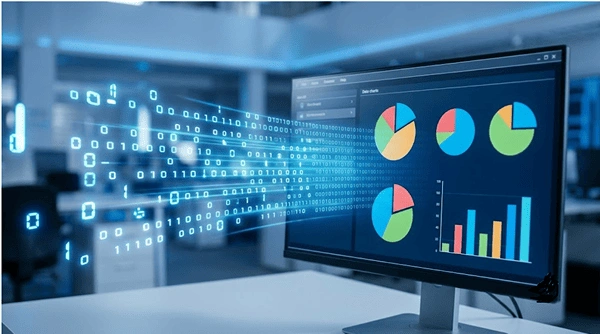
Real-time analytics is the process of collecting data, storing it, analysing it, and converting it into actionable insights and dashboards so that businesses can make quick decisions about products, services, or offers. The main target is to analyse live data within a few seconds between data creation and analysis.
There are two types of real-time analytics;
- On-demand real-time analytics: The system shows the answer only when someone or any automation asks a specific query.
- Continuous real-time analytics: The system starts working automatically on existing data and shares insights without any request.
Real-Time Analytics Vs Batch Analytics
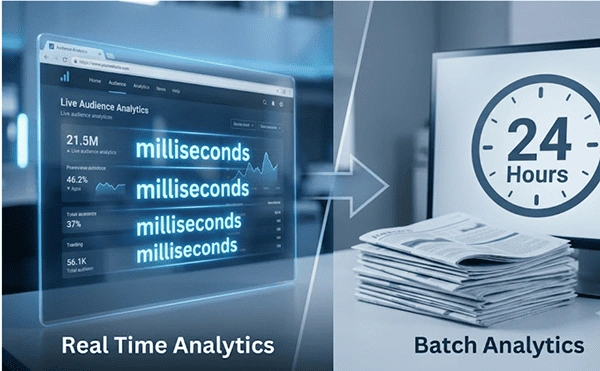
Real-time analytics works by analysing the latest data as it is created and gives useful insights that help brands take quick actions for products and services. For example, the live audience on a website.
Batch analytics is a process of working on data that is collected over a specific time and analysing it as per a fixed schedule. For example, a regular sales report of a Reliance Fresh store.
Here is a table that shares the differences between these two terms.
| Factor | Real-Time Analytics | Batch Analytics |
| Query scope | Most recent record or window | The entire dataset |
| Latency | Milliseconds to seconds | Minutes to hours |
| Best for | Instant decisions and alerts | Scheduled reports and trends |
| Data type | Dynamic, time-sensitive data | Static, historical data |
Note: Some companies use both real-time analytics and batch analytics together. The batch layer works with deeper analysis, while the real-time layer gives immediate reports for making quick actions.
How Real-Time Analytics Works

Real-time data analytics works with past data as well as live streaming data. It helps companies get the latest information quickly via reports, dashboards, or even automated applications.
This process works in four simple steps:
- Data collection: Data is collected from different sources, such as websites, server logs, mobile apps, and IoT devices. Latest tools like Change Data Capture, also known as CDC, help collect data as soon as it is created.
- Data processing: Live stream processing tools like Amazon Kinesis or Apache Kafka can easily handle incoming data smoothly, even if it spikes randomly. These are capable of handling trillions of data points instantly.
- Analysing or storing data: After filtering, grouping, and comparing data in multiple platforms like Google BigQuery, Snowflake, or ksqlDB, data is safely stored in cloud-based storage to analyse in the future.
- Insights generation: There are some machine learning and analytics tools that examine the data, create valuable reports, and share interactive dashboards that help take quick actions.
Databricks has a lakehouse architecture feature, which works with Apache Spark Structured Streaming. It allows people to use the same Python and SQL code for real-time as well as batch data, which means there is no need to manage different systems for unstructured and structured data.
Note: Real-time analytics is one of the main aspects of data streaming with real-time applications and machine learning. These all work together; for example, if it detects a suspicious transaction, it automatically blocks it within a few seconds to prevent further loss.
Benefits of Real-Time Data Analytics

One of the major benefits of real-time data analytics is speed. It lets business owners act quickly as per situations, make quick decisions, and be ready for upcoming challenges.
Here are some more benefits:
1) Quicker decisions: Tracking market changes and customer behaviour using the live dashboard and system alerts.
2) Decreasing fraud: Can easily detect fraudulent transactions, inventory management, or possible cyber-attacks quickly so that immediate actions can be taken to prevent further loss.
3) Efficiency improvement: People in production work with the live data for products and services rather than waiting for daily and weekly reports.
4) Better predictability: The latest tools that integrate machine learning and artificial intelligence can easily predict near-future possibilities and result in extra profits.
Different teams use real-time analytics in different ways:
- Data analytics creates live reports and dashboards using streaming data.
- Operation teams maintain stocks and enhance supply chains
- Business managers actively track key performance indicators
- IT teams detect security threats and prevent them.
Note: Real-time analytics is in high demand. As per the Precedence Research, the international analytics market is valued at 83.79 billion dollars in 2026, which is expected to reach 785.62 billion dollars by 2035.
Real-Time Data Analytics Tools and Platforms
The best real-time analytics tools are Databricks, Amazon Kinesis, Qlik, and Apache Spark. These tools start data collection as soon as it is created, process it quickly, even in milliseconds, and show the insights with the help of interactive dashboards or other platforms. Most systems already have relevant tools for collecting data, processing it immediately, and converting it into insightful reports.
Here are some common real-time analytics platforms:
| Tool / Platform | Primary Role |
| Qlik | Real-time reporting, dashboards, and CDC |
| Amazon Kinesis | Managed real-time data streaming on AWS |
| Apache Spark | Large-scale stream and batch processing |
| Databricks | Lakehouse platform for streaming, ML, and SQL |
| Apache Kafka | Distributed streaming and message broker |
| Snowflake / BigQuery | Cloud storage and querying of stream data |
Real-time analytics can start processing data in milliseconds. The speed becomes a major point to detect discrepancies, track suspicious activities, and identify possible fraud quickly.
Real-Time Analytics in Healthcare and Other Industries
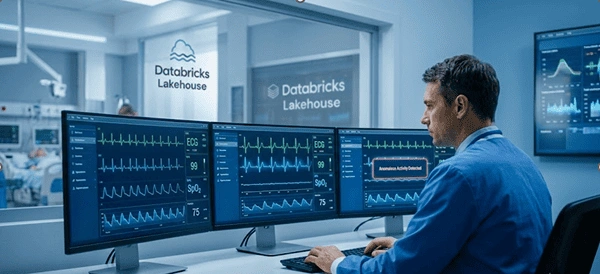
Real-time analytics in healthcare focuses on monitoring patients’ crucial symptoms based on history, observing anomalies, and informing medical staff about possible health dangers before these get out of control. Databricks shows the healthcare sector is at the top amongst others, where real-time insights drive useful results.
Here are the main case categories for real-time analysis;
- Performance optimisation: Apply changes quickly to enhance overall work quality as conditions change. For example, a logistics organisation may take a different route if there is a road closure or traffic delays, which helps deliver consignments even faster.
- Real-time personalisation: Displays people, products, services, or offers based on in-app user activity. For example, if anyone searches for shoes online, websites are more likely to show them ads for shoes.
- Preemptive maintenance: Keeps checking machines actively to detect problems before they start malfunctioning. It lets business owners repair or replace faulty parts to avoid work stoppage.
- Fraud and error detection: Maintains a close eye on every transaction and compares it with previous ones. If it finds any unusual activity, like a large transaction from a different location, it signals the system to temporarily stop the transaction to protect against fraud.
Note: Some more industries that use real-time data effectively include social media to know trending topics and user intent and manufacturing companies to detect early machine faults.
Challenges of Real-Time Analytics
Real-time analytics is an effective way to understand the insights quickly, but there are some challenges too. Professionals must be aware of these major points while working on a real-time analytics system.
- Scalability: Streaming datasets may sometimes generate terabytes of data that proliferate rapidly; therefore, using cloud-based storage can handle the load easily.
- Durability and consistency: Data keeps displaying in the system, which may gather and become older if there is no lineage or governance layer applied.
- Fault tolerance: The system must be capable of handling many formats without failing at a single point.
- Cost: The latest tools to make real-time analytics cost more, and the team must understand what real-time actually means so that they agree to buy them.
Dos and Don’ts of Real-Time Analytics
Remember these useful dos and don’ts in mind while working on real-time analytics.
Dos
- Always store live data in cloud-based storage to handle volume spikes smoothly.
- Add a fault detector stream tool like Kinesis or Kafka for data accuracy.
- Use a batch layer along with a real-time layer to cover the full data.
- Include data governance and lineage for reliable insights.
Don’ts
- Don’t go with just real-time analytics when a detailed batch report delivers better results.
- Don’t avoid data ordering to deal with discrepancies in records
- Never ignore cost or avoid training teams for new pipelines.
- Don’t represent reports by applying a fault tolerance layer and data governance.
Conclusion
Real-time analytics works on streaming data and convert it into clear and actionable insights, which teams use for customised experiences, detecting fraud, and preventing downtime to make faster decisions based on results. The tools which data analysts use for real-time analytics are Spark, Kafka, Databricks, and Qlik in high demand. Begin by answering real business questions, choose the relevant pipeline, and connect useful layers with existing data.
FAQs
What is real-time analytics?
Real-time analytics is the process that includes collecting and analysing live data as soon as it is updated. It helps publish reports based on the latest data, which businesses use to make profitable decisions, rather than waiting for daily or weekly reports.
How is real-time analytics different from batch analytics?
Real-time analytics creates insights and reports using the latest data that business owners use to make better and earlier decisions. While the batch analytics works on old datasets that first store data and then analyse and create reports.
What are common real-time data analytics tools?
Here are the most common tools, such as Apache Kafka and Amazon Kinesis for data streaming, Databricks for processing live data, and Snowflake to store it in databases for querying data.
How does real-time analytics play an important role in healthcare?
Experts use real-time analysis to observe patients’ major symptoms, detect diseases, and inform doctors about possible health problems, which leads to faster procedures and better results for patients.
What are the main use cases for real-time analytics?
There are four major categories of real-time analytics, including;
- Real-time personalisation
- Fraud and error detection
- Preemptive maintenance
- Performance optimization
These four work in almost all the categories, like finance, manufacturing, energy, e-commerce, and social media.
Sources:
- Data Analytics Market Size, Share, and Trends 2026 to 2035 by Precedence Market
- What is Real Time Analytics? by Databricks
- Real Time Analytics By Qlik