ETL Process Optimization: Benefits, Challenges, Tools, and Modern Techniques in 2026
ETL process optimization is the way to improve the collection, transformation, and storage of data. It improves performance and ensures accurate reports. That is why it helps business owners to handle large datasets frequently and easily.
So, being a business owner, you should explore ETL process optimization, techniques, performance improvements, benefits, and challenges here. You can also discover ETL tools that help you manage millions of raw data records.
Let’s stick to this article!
- What is the ETL Process?
- What is ETL Process Optimization?
- Modern ETL Process Optimization Techniques in 2026
- What are the Benefits of ETL Process Optimization?
- What are the Challenges of ETL Process Optimization?
- ELT Vs ETL: Choose the Right Structure
- ETL Optimization Tools Comparison
- The Bottom Line
- Frequently Asked Questions
What is the ETL Process?
ETL stands for “Extract, Transform, and Load.” It is a process of collecting data from different sources, fixing errors and formats, and storing it in a data warehouse.
The ETL process involves three steps that help you with data collection, transformation, and storage.
1. Extraction
The first stage of this process is extraction. The main purpose is to gather data without structuring it from various sources for the next stage. The sources include SQL, NoSQL, JSON, XML, emails, webpages, and flat files.
2. Transform
This stage basically works to structure data, fix errors, and remove incorrect information. It also summarizes data for better real-time analytics and insights for the business. This makes it important to improve data standards.
Did You Know?
The transformation stage also does more complex tasks like currency conversions, text normalization, and applying domain-specific rules. It helps you align data according to your preferences.
3. Load
When the data is collected and cleaned, it’s time to transfer it to the database/data warehouse or data lake. The final stage, “loading,” stores new and updated data into a target data storage system for efficient use.
Now that you understand the ETL process, let’s move on to ETL process optimization.
What is ETL Process Optimization?
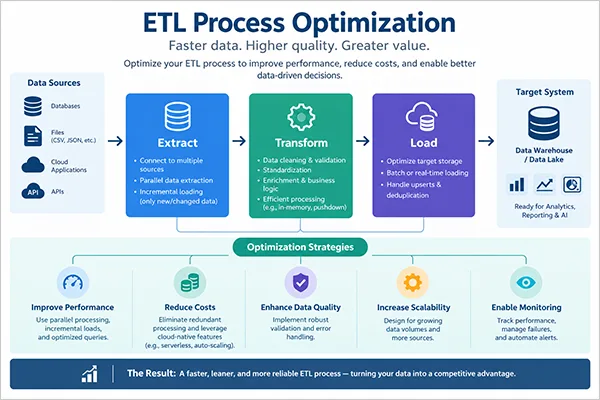
ETL process optimization improves the ETL process. In simple words, it improves the way data is collected, cleaned, and stored so that the process becomes faster and more accurate.
This reduces work time delays, lowers cloud computing costs, and ensures data reliability. It indicates that a well-optimized ETL process can provide high-quality data flow through ETL pipelines.
According to Tam Herbert from MIT Management Sloan School, companies have around 80-90% of unstructured data, such as images, videos, text, files, web pages, etc. For this reason, ETL process optimization is essential for structuring information.
Structured data is a gem for businesses and helps them make better decisions.
Modern ETL Process Optimization Techniques in 2026
You should focus on high-quality data, use parallel processing, leverage incremental data loading, monitor the ETL pipeline, and implement parameterization and code reuse.
Here are the modern ETL process optimization techniques that you must follow for better outcomes.
1. Focus on High-Quality Data
High-quality data is easier to analyze. So, you can implement robust validation checks during the time of extraction and transformation. It helps you ensure that your data is clean, reliable, and easy to analyze. This reduces overall burden and improves the ETL process.
2. Use Parallel Processing
Parallel processing means doing multiple tasks simultaneously. Whether it’s collecting or transforming data, using parallel processing can help you handle large datasets. It will automatically reduce the runtime and boost efficiency.
3. Leverage Incremental Data Loading
Incremental data loading means processing new and changed data rather than loading the entire dataset every time. For example, you have 10,000 customer records, but you should store only the new or updated records. It reduces your processing time and resource usage.
4. Monitor and Handle the ETL Pipeline
You should regularly monitor your ETL pipeline to check for slow processes, errors, and bottlenecks. Also, you can use performance metrics to identify processing time, data volume, and failure rates. It adjusts queries, improves processing time, and boosts performance.
5. Implement Parameterization and Code Reuse
Parameterization allows ETL pipelines to use flexible data and values without extensive code changes. You can easily manage the process for file paths, documentation, database connections, and transformations.
Code reuse means using the same templates and structures for similar tasks. It reduces workloads and improves the development process. This also prevents you from repetitive coding and makes your ETL process scalable.
Also Read: 10 Best Cloud Data Warehouse Solutions in 2026: Platforms and Features
What are the Benefits of ETL Process Optimization?
If you focus on ETL process optimization, you can easily reduce processing time, enhance data and visualization stability, and increase credibility and reliability.
Let’s take a look at these benefits in great detail.
1. Reduce Processing Time
The ETL process can reduce processing time and provide insights faster than usual. With optimization, a business can generate real-time customer reports within 30 minutes instead of 3 hours. It helps them access urgent information easily and make informed decisions.
2. Enhance Data and Visualization Stability
ETL optimization also improves data quality, which in turn leads to more reliable visualizations and reports. It helps business owners and stakeholders use data visualization technique that monitor structured, reliable, and information for better decisions.
3. Increase Credibility and Reliability
If you have structured and reliable data, it automatically builds your credibility among stakeholders and other investors. You can also implement data validation and data quality checks at various stages to ensure your data is accurate.
What are the Challenges of ETL Process Optimization?
Businesses might face challenges like poor data quality, scalability issues, large data volumes, and complex transformations in ETL process optimization.
Here are the challenges you face in the ETL process.
1. Poor Data Quality
Raw data from different sources is inconsistent, incomplete, and inaccurate. This makes the processing slow and more difficult to manage. Poor data quality can also lead to incorrect reports and affect business decisions. So, data quality management is necessary for accuracy.
2. Scalability Issues
When your business grows, your data volume and processing time also increase. This affects your ETL pipelines that work well with small datasets. That is why you need to design an ETL pipeline that handles workloads and optimizes challenges.
3. Large Data Volumes
Millions of records and large volumes can increase processing time. You will need large computing power, memory, and storage. So, you should implement efficient techniques like parallel processing and incremental loading for effective solutions.
4. Complex Transformations
In the second stage, data often requires various calculations, cleaning processes, and formatting. This automatically makes ETL pipelines harder to maintain. For this reason, removing unnecessary operations can simplify transformations.
ELT Vs ETL: Choose the Right Structure
ETL stands for Extract, Transform, and Load, while ELT stands for Extract, Load, and Transform. These two techniques are different in collecting, loading, and storing data.
1. Order of Operations
- ETL first transforms, cleans, and structures data before storing it into a final destination.
- ELT first stores data in a data warehouse, then performs transformations.
2. Use Cases
- ETL focuses more on transformation than storage. It is best for structured data and removing errors before loading into a database.
- ELT is suited for cloud-based environments and big data platforms that store millions of records using computing power.
3. Performance
- ETL takes more processing time in the transformation stage and delays the storage step.
- ELT pipelines take advantage of parallel processing techniques in modern databases and reduce processing time.
4. Flexibility
- ETL focuses precisely on data transformations rather than storing it.
- ELT provides flexibility in raw, unstructured, or semi-structured data.
After understanding the difference between ETL and ELT, you can easily choose the right data pipeline for your business operations.
Also Read: What is a Columnar Database? When Should You Use or Avoid a Columnar Database?
ETL Optimization Tools Comparison
Choosing the right ETL optimization tools is also important for better performance. Here is a comparison of ETL tools that helps you make informed decisions.
| Capability | Datalance | Fivetran | Airbyte | Matillion |
| Incremental loading | Built-in CDC + timestamp | Built-in CDC | CDC + cursor-based | Built-in CDC |
| Parallel processing | Native | Native | Configurable workers | Native |
| Built-in warehouse | Yes (Postgres/Trino) | No – BYOW | No – BYOW | No – BYOW |
| SQL + Python transforms | Both native | SQL only (via dbt) | SQL via dbt, Python limited | SQL-first, Python SDK |
| AI-assisted optimization | NL to SQL, auto-quality rules | Limited | AI connector builder | AI-assisted transforms |
| Reverse ETL | Built-in | Separate product | Community connectors | Limited |
| Connectors | 250+ (48 hr custom SLA) | 500+ | 550+ (open source) | 100+ |
The Bottom Line
ETL process optimization requires consistent monitoring and advanced techniques. It reduces processing time, improves performance, and ensures report accuracy. This makes it ideal for collecting, transforming, and storing data for business operations.
As a business owner, you should also focus on enhancing ETL pipeline performance and flexibility. You can opt for Datalance data engineering services to resolve ETL process problems. Their engineers provide pipelines, integrations, and warehouses that align with your preferences.
Frequently Asked Questions
Will ETL be replaced by AI?
No, AI will not replace ETL. But it improves the extraction, transformation, and loading significantly. It also automates routine tasks, coding, and other integration work.
Is the ETL process difficult to learn?
Yes, the ETL process is difficult to learn, especially for non-tech people. But you can go for data engineering services for ETL process optimization.
Are ETL and SQL the same?
No, ETL and SQL are not the same. ETL is the process of collecting raw data, cleaning unnecessary information, and storing it in a data warehouse. On the other hand, SQL is a programming language that is used to write instructions.
Which AI tools are best for checking the ETL process?
Datagaps ETL Validator, QuerySurge, and Informatica Data Validation (DVO) are best for checking the ETL process.
Sources: