What Is Data Mining? Definition, Process, Techniques, Examples & Benefits
In the current landscape, it cannot be denied that organizations are operating with a large amount of data. To make more sense of the accrued data, the concept of data mining is employed.
Mining is a scientific technique that helps in analyzing it more strategically.
The concept of mining has been around for a long time. Today, companies are harnessing data mining and machine learning to get valuable information from large data sets.
This guide will discuss how it transforms businesses with powerful insights. Besides that, we will also focus on techniques, processes, benefits, and examples.
Let’s explore this concept in detail.
What is Data Mining?
Data mining is the process of extracting useful insights, patterns, correlations, and more from large data sets using statistical methods and database systems.
If we have to explain the data mining definition in simple terms, we’ll say, “It is the process of identifying patterns from huge amounts of data.”
It involves:
- Structured data
- Unstructured data
Some examples include:
- Predicting customers’ habits on a social media platform.
- Recommending products based on past behavior.
How Does Data Mining Work?
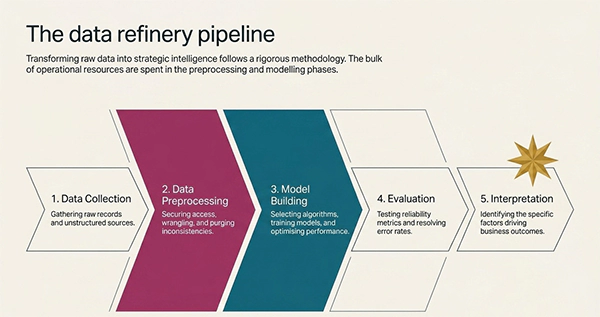
Data mining is really simple; just utilize tools like machine learning, statistical analysis, and other analytical tools for parsing raw data. It helps you discover hidden patterns that can be used to gain insights.
However, the exact steps of mining depend on the content, organization needs, and raw data needed for analysis.
Having said that, let’s take a look at typical steps involved in a data mining process.
1. Data Collection
- Of course, the first step is to gather raw data from various sources. It may include your company, social media, IoT, and more.
2. Data Preprocessing
- You must review the data sources for the technique. Ensure that you have the rights to access and use the external data, such as demographics, economic, and market intelligence.
- Then go for wrangling or munging, where you engage experts to help define, categorize, and organize the data.
- Data cleaning also comes in this step. It includes removing duplicates, purging inconsistencies, or cleaning outdated formats.
3. Model Building
- After you are done with data processing, assign engineers to select relevant algorithms and techniques–decision trees, regression, or clustering.
- Once it is done, train multiple models on preprocessed data. To optimize performance, you are suggested to make last-minute changes to the algorithm.
4. Evaluation
- Evaluate key metrics: accuracy, precision, and error rates
- Check if any issues arise. If so, resolve them.
5. Interpretation
- When all is said and done, you can identify the factors that are greatly affecting the predictions and outcomes.
Key Data Mining Techniques
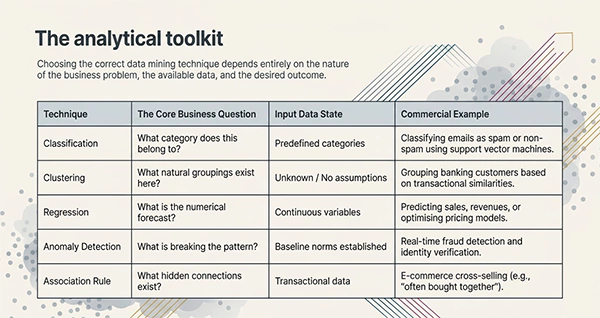
When it comes to data analytics, you’ve got a lot of different techniques to choose from. The one you pick will really depend on what you’re trying to resolve, what kind of data you have to work with, and what you are hoping to get out of.
Let’s check out these mining techniques.
- Classification – Classification assigns data into a predefined category. For example, classifying emails as spam or non-spam.
- Clustering – As the name suggests, it groups data based on natural similarities. If we take the example of a bank, clustering transactions by spending pattern can surface outliers.
- Regression – This is a numerical data mining technique that is used for predicting things like sales, revenues, or stock prices. By analyzing data, companies can predict future trends in a business. Various businesses also utilize this model for optimizing pricing models, price demand, and more.
- Anomaly Detection – It detects unusual patterns that are different from normal. Well, it can come in handy when dealing with things like fraud detection, fraud prevention, network security, and identity verification.
- Association Rule – This mining technique links two seemingly unrelated events or activities. A classic example of this technique can be found in the e-commerce sector, where users see products “often bought together.” This type of technique helps in cross-selling, product placement, and recommendations.
Benefits of Data Mining in Business
In the modern era of a data-driven world, most organizations rely on data mining. It offers a number of benefits, including:
- Improved Decision Making – Giving businesses accurate insights enables them to make data-backed decisions and remove guesswork from the picture.
- Customer Personalization – It is easy for businesses to harness the potential of data to tailor products and services to their customers’ needs. Personalized offers and recommendations improve the user experience.
- Fraud Detection – By analyzing and identifying anomalous patterns, mining techniques can detect fraudulent activities. By using this, finance, insurance, and cybersecurity companies can have enhanced security.
- Operational Efficiency – Mining is a great way to optimize supply chains, reduce costs, and streamline workflows.
- Competitive Advantage – If there are hidden trends to be unlocked, mining will help in that endeavor. So, this can also give you a competitive advantage in the business world.
Also Read: What is a Data Scientist?
Challenges in Data Mining
Aside from these amazing benefits, data mining is also fraught with a few challenges. Have a look.
- It can incur data quality issues due to inaccurate, incomplete, or noisy data.
- When managing vast amounts of data, powerful systems are required. Or scalability can be a nightmare for most people.
- Since the data is sensitive, companies fear for its privacy.
- It’s always challenging to choose the right algorithm for a specific dataset. If you are less than perfect in choosing, accuracy and reliability cannot be guaranteed.
- It may be troublesome to combine structured and unstructured data from multiple sources.
Applications or Examples of Data Mining
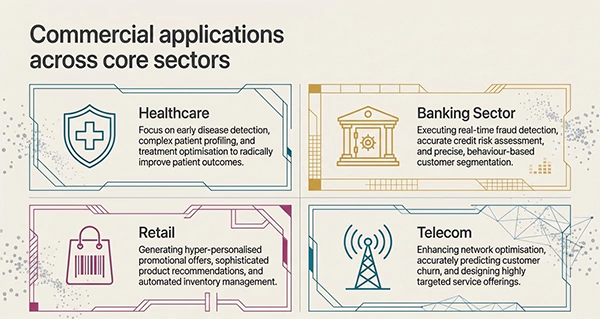
Data mining is a gold mine for businesses, as it helps them uncover insights that let them serve customers better and increase revenue.
- Banking Sector – Data mining helps in fraud detection, credit risk assessment, and customer segmentation in the banking sector, as it is one of the most important aspects of banking.
- Retail – The retail sector has a lot of potential. Here, the data is used for personalized promotions, recommendations, and things that matter to customers.
- Healthcare – We know that healthcare is of utmost importance to governments and, most importantly, people. So, in this, it can help in early disease detection, patient profiling, and treatment optimization.
- Telecom – Enhance network optimization, churn prediction, and targeted service offerings.
Also Read: Data Lake vs Data Warehouse
Conclusion
Data mining refers to the process of designing patterns and drawing insights from massive datasets based on several statistical models.
With the knowledge of data mining meaning and the application of its various techniques such as classification, regression, and clustering, businesses will be better positioned to understand their customers and stay one step ahead of their competitors.
In the coming years, as data science evolves, businesses that embrace data mining will be in a better position than others.
If a business requires assistance in implementing these techniques at a large scale, our data mining services can help in data collection, processing, and analysis based on the requirements of the project.
FAQs
What do you mean by data mining?
Data mining is the process of creating insights and finding patterns from huge datasets using statistical models.
What are the key techniques of data mining?
The key techniques are: classification, regression, clustering, association rule mining, and anomaly detection.
What industries is data mining used in?
Data mining is used in various industries such as education, healthcare, finance, manufacturing, and more.
Sources:
- What Is Data Mining? – Oracle
- What is data mining? – IBM