What is a Data Scientist? Learn Their Responsibilities, Skills, Scope, and Much More
When British mathematician and data science entrepreneur Clive Humby said, “Data is the new oil,” nobody knew it would produce a whole new discipline of data scientists working on this oil.
People, especially youth, understood this more clearly when Harvard Business Review called data science the sexiest job of the 21st century.
Now, the data scientists are paid hefty amounts for just working on data and predicting trends. But it’s not as simple as it seems.
If you are also keen to know what is a data scientist, then this whole account will help you explore all its dimensions and will answer all your doubts in a crisp and concise way.
What Is Data Science?
The US Census Bureau defines data science as “a field of study that uses scientific methods, processes, and systems to extract knowledge and insights from data.”
Although it seems a single professional expertise, it is a multidisciplinary field with significant links to statistics, computer science, mathematics, and domain-specific knowledge. This broadens its scope to diverse sectors like healthcare, corporate, environmental studies, and more.
The need for this discipline appeared when the demand to reap the humongous data generated by people was felt.
But out of this data, not everything is segregated, not every piece of information is worth your attention, and not every piece of data you extract is productive.
That is where data science comes in and simplifies handling such data.
Now let’s take a look at its origin and how it got shaped over time.
Origin And Development Of Data Science
The term “data science” was coined by Peter Naur, a data scientist and a Danish astronomer. For his contribution to the field, he was honored with the Turing Award in 2005, which is one of the highest recognitions in computer science.
But the actual credit to elevate it to a distinct discipline goes to William S. Cleveland, an American computer scientist.
Since its inception, it has gone through many revolutionary turns, such as the big data explosion in the 2000s, cloud infrastructure development, modern data stack support, and now the burst of interactive generative AI.
The trajectory indicates its direction toward more democratic and decentralized operations for yielding more from the piling data.
What is a Data Scientist?
A data scientist is a professional who utilizes his/her knowledge and experience to harness the available data to assist firms in making more data-backed decisions. This simple data scientist definition covers not just their role but also their importance.
In simple terms, just dissect it into individual words, i.e., DATA (information) + SCIENTIST (deeply working on something).
They are actually a kind of problem solver who uses the available data to predict the future direction and aid in making decisions in line with decided goals.
The most interesting part is that one can learn through normal courses and practice them over and over again to fine-tune the expertise. If interested, you can go for a master’s degree too to boost your knowledge in this discipline.
Talking about the pay and perks, according to Robert Half, one of the best job portals in the US, the average salary of a data scientist in the US ranges from $121,750 to $182,500. This variation considers the different profiles within this discipline and also the variation in the salary across different states and firms.
Types Of Data Scientists
A data scientist is not a monotonous career but has certain sub-levels beneath. The top and most preferred are:
| Data Engineers | Design the system that stores and transfers data |
| Data Visualisation Specialist | Transforms bulk data into visually understandable graphics. |
| Data Architects | Define and design the data architecture in an organization, especially in large companies. |
| Business Analyst | Understand the trends, detect issues, and find opportunities for brand success. |
| Machine Learning Engineers | Develops algorithms to make predictions and automate required decisions. |
What Does A Data Scientist Do?
A data scientist segregates the data into useful categories, analyses them, builds predictive models, conducts data visualization, and develops business strategies.
Let’s understand data scientist duties one by one.
- Data Segregation: The data is not stored in one place. It comes from different devices like gadgets, IoTs, etc. Gathering, sorting, and extracting the meaningful data is one of the prime tasks of data scientists.
- Data Analysis: Here, such scientists analyze the data to understand the trends and derive the direction of the possible human inclination to make informed decisions. The application of statistics and identifying the relationship between the variables is a challenging task in this field
- Building Predictive Models: As a data scientist, you will select the appropriate machine learning algorithm, such as a neural network or a decision tree. Further, splitting data into training and test sets and conducting hyperparameter tuning are also essential parts.
- Data Visualization: One of the most important duties of a data scientist is to make the data visually comprehensible and easy to grasp. Using charts, diagrams, graphs, treemaps, histograms, Venn diagrams, and other techniques makes this task easy. These days, Power BI, Tableau, and D3.js are considered the top tools for it.
- Developing Business Strategies: The insights derived from the data are also used in framing the strategy to redefine the direction of the business or set goals.
- AI Integration: The data scientists are also involved in developing the solutions integrated with AI. Smart chatbots, fraud detection and grievances redressal systems, and even AI-based recommendation systems in e-commerce sites are some of its examples.
After going through the data scientist duties, the next important thing is the skills required in this profession.
What Are The Key Skills Required In A Data Scientist?
The key skills required in a data scientist are mathematical and statistical expertise, deep understanding of machine learning, programming, data visualization, data wrangling, and data visualization. Besides, some soft skills are also necessary for it.
Here are the major skills you require to become a data scientist.
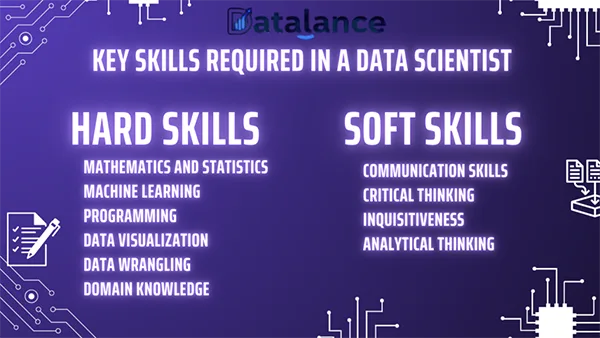
- Mathematics and Statistics: This helps in understanding complex data, testing hypotheses, and building models from the available information.
- Machine Learning: Understanding machine learning helps in selecting and implementing relevant algorithms and evaluating their performance.
- Programming: Having a significant understanding of Python, R, and SQL is essential to conduct statistical analysis and understand data manipulations.
- Data Visualization: The cluttered data is of no use. So data visualization helps classify and exhibit the data in a visually comprehensive way through charts, tables, and graphs to make it more understandable.
- Data Wrangling: It means cleaning and preparing data for appropriate usage. Through this, data is refined to make it more useful.
- Domain Knowledge: You must have a decent understanding of the field you work in, i.e., finance, IT, entertainment, or governance, to seize every opportunity from the data available in your domain.
Some soft skills are also required in this profession, which are:
- Communication Skills: Having good interpersonal relations through good communication skills enhances your cooperation in your team. You work as a link in the chain of getting data and giving results. Act your part with utmost decency.
- Critical Thinking: Utilize objective facts before arriving at any conclusion to make smarter decisions.
- Inquisitiveness: You must have the drive to learn the reason behind every point you encounter.
- Analytical Thinking: Through this, you understand abstract issues and find their solutions
After understanding all its dimensions, let’s learn how you can become a data scientist.
How To Become A Data Scientist?
To become a data scientist, complete your bachelor’s degree, opt for a Master of Science in Data Science, enroll in a course and earn certification, and get practical experience through freelance projects or internships.
Here is a step-by-step process for opting for this career option.
- Complete Graduation: The first step in the process is to get a bachelor’s degree in computer science, statistics, mathematics, or data science. Some universities also accept non-technical degrees, but mostly technical degrees are preferred.
- Get into Postgraduation: Completing a Master’s of Science in data science or similar fields will help in ingraining its fundamentals. Also, the support from faculty, practical application of knowledge, and regular feedback will imprint the nitty-gritty in your mind.
- Earn Course Certificates: Completing courses and earning certificates further strengthens your hold over this discipline.
- Gain Experience: Start with an internship, get projects on your own, and participate in hackathons or competitions to gain experience. You can also start working as a freelance data analyst or join as a junior data scientist at a reputable firm to start your career.
Here, the most important points to consider are that you have to keep upgrading your skills and knowledge, especially the understanding of programming languages such as Python, SQL, and R.
What Is The Scope Of A Data Science?
The scope of data science covers fields like health, finance, environmental science, entertainment, telecom, governance, and utilities.
In clear terms, it can be employed in any field where significant data is available, and valuable inferences can be derived from it. Now let’s take a look at these fields and understand how data science helps.
- Health: In the health sector, data science is highly beneficial in drug discovery, bioinformatics, and medical image analysis.
- Business and Finance: Algorithmic trading, risk analysis, and strategic decision-making by analyzing and segregating customer data can be achieved by harnessing data science.
- Environmental Science: An environmental data scientist conducts machine learning algorithms, uses regression analysis to understand the environmental trends and patterns, and predicts the results of prospective issues.
- Industrial Processes: A data scientist can help you in predictive maintenance and optimizing operations, which not only reduces downtime but also expands the business.
- Governance: It helps in making public policy decisions by harnessing gigantic socio-economic data, demographic trends, and statistics. This also helps in social interventions like last-mile service delivery and strategic planning, such as urban planning and poverty alleviation approaches.
- Transport: Here, developing a car monitoring system and enhancing the driving experience are some of its uses. Besides, enhancing driver safety and developing self-driving cars also demand the application of data science.
Conclusion
Now that you have learnt what is a data scientist, it’s high time you gear up for it. Enroll in a course, start from fundamentals and approach advanced skills, keep brushing up on your programming capabilities, and get hands-on experience through projects and internships. Initially, it might look tough and full of stats and figures, but gradually you will develop interest, and as the salary figures show, it is a lucrative job too.
FAQs
Q1: What exactly does a data scientist do?
Ans: Data scientists extract, segregate, analyze, and derive meaningful insights out of it, which helps in making data-backed decisions.
Q2: What is the salary of a data scientist?
Ans: The average salary of a data scientist in the US ranges between $121,750 – $182,500. However, this may go even higher and lower in other countries, depending on their scope in that region.
Q3: Will AI replace data scientists?
Ans: No, AI will not replace data science but will integrate with it, saving time and effort in generating valuable insights.
Q4: What degree is needed for data science?
Ans: Although any particular degree is not needed for data science, having a technical educational background is preferred for its master’s degree.
Sources:
- Data Scientists by the US Bureau of Labor Statistics
- How to Become a Data Scientist by Harvard School of Engineering and Applied Science
- What Does a Data Scientist Do? By Northeastern University, Boston