Data Ingestion: Definition, Types, Use Cases, Benefits, Challenges, Capabilities, & More!
The data ingestion is a simplified way of dealing with data silos. Every type of business, these days, leverages the power of software and advanced cloud-based IT infrastructure. That inevitably leads to the accumulation of important information in scattered places. To streamline data management and processing here, a centralized repository is a must.
Without it, downstream business intelligence and analytics cannot be performed at all. Learn more about this capability in the following reading. All the major aspects are covered with simplicity of language and easy structuring.
What is Data Ingestion?
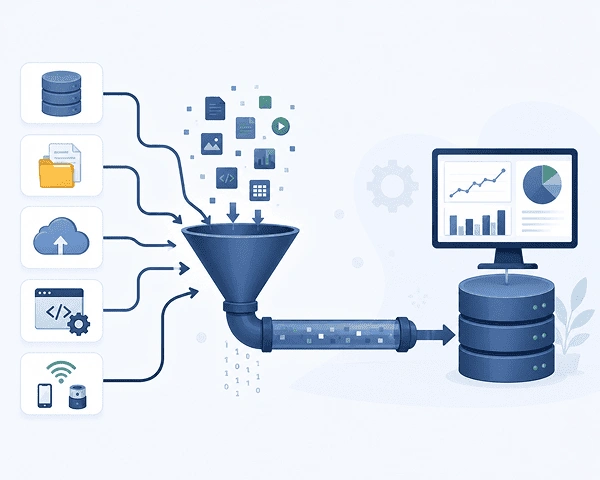
If you are confused about “What is data ingestion?”, it is nothing but a process to transfer all your important scattered data to a single platform. It allows for better processing and analytics. The concept can’t be simplified more than that! The objective of this business activity is to streamline data storage and analytical capabilities.
All the data that is strewn over many places, i.e., ERP, CRM, SaaS platforms, etc., is unified and made more accessible.
Do you know? AWS Glue, FME, Informatica PowerCenter, and Ab Initio are the top software in this domain! These tools are very important for the work of data analysts.
Types of Data Ingestion
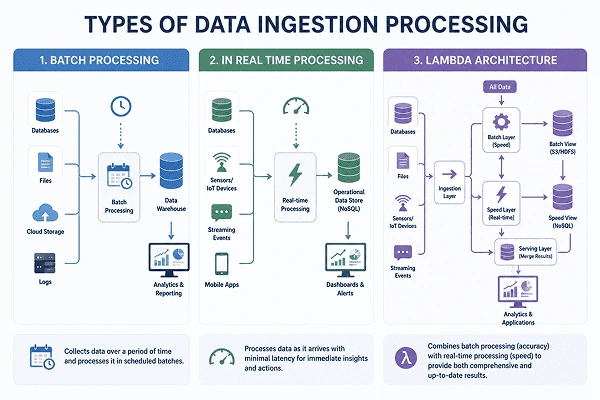
After information ingestion meaning, let’s explore the types of this key data management activity. The three ways of ingesting data are batch processing, real-time processing, and lambda architecture.
- Batch processing: This method stands opposite to real-time transfer. Here, the data from many sources is collected and shifted to the destination in manageable quantities, one after another. Each quantity of data being transferred at a specific point in time is called a batch. That makes the process easier to handle.
Note: A number of batches can be scheduled for transfer through automation. Or, each can be handled by a user individually after the previous one is complete. Both capabilities are available in most data analysis tools.
- Real-time processing: This form of ingesting data is also known as stream processing. Here, the scattered data is transferred from sources to a target in real time, in a continuous stream. Apache Kafka allows you to do that seamlessly.
- Lambda architecture: It is a combination of both the above-mentioned data ingestion methodologies. Data is transferred to its destination platform in batches as well as in real time!
Do you know? ETL pipelines support the processing of large data in smaller and manageable batches.
Key Stages in the Data Ingestion Process
The major stages of the data ingestion process are as follows.
- Discovery
- Extraction
- Validation
- Transformation
- Loading into the destination
Each one of these is explained below.
- Discovery: It is the stage where the user tries to determine how many platforms the data is scattered across. Discovery is the first stage in this workflow. It allows the user to see which information is crucial and which can be left behind.
- Extraction: After the discovery, the extraction of the important data begins. Your information travels from the various sources to the target data warehouse. Each source needs a specific strategy.
Do you know? The task becomes highly complex if your data is all over various platforms. However, a technical person can handle it with ease.
- Validation: The third step in the process belongs to data validation. In other words, you have to make sure that it is error-free, complete, and consistent. If it has any errors, for example, heavy repetitive, inaccurate records, etc., it will ruin your data warehouse. And the redo will take a huge amount of time and resources. Thus, always check the arriving data carefully before it enters the lake.
Note: This step is very important for accurate business analytics and quality decisions for real benefits.
- Transformation: When all the information has been validated, it is time to transform the approved data into the right format. Many let the target or data warehouse deal with this task after loading. But some prefer to give it a standard shape before it enters the warehouse.
- Loading into destination: It is time to let the final data flow into the data lake and become unified for better accessibility.
Also learn: Data scientists heavily rely on such unified data warehouses or lakes for broad insights into their subject of study.
ETL Vs ELT in Data Ingestion
The data ingestion meaning is putting all your data from different software into one place. This process depends on two workflows. The first one is ETL, and the second one is ELT. Both are elaborated upon below.
- ETL: It stands for Extract, Transform, and Load. That describes a specific data ingestion pipeline. Here, the data is extracted from a source and then transformed into a suitable format. Once that much is done, the input is finally fed into the repository.
- ELT: It stands for Extract, Load, and Transform. And what is unique about it is that the sourced data is loaded first into the data lake and then transformed for uniformity.
Both of these are known as major data transfer pipelines.
Benefits of Data Ingestion
What ingestion does to your data is unification and simplification. It has several advantages, ultimately leading to reduced operational costs. In short, major benefits include data accessibility, better insights, advanced analytics, data uniformity, enhanced user experience, automation, and cost savings.
- Data accessibility: All your data silos are highly inaccessible and of no practical use unless integrated into one platform. That is what data ingestion makes possible. So, you get a complete picture of all the crucial aspects, i.e., sales, marketing, inventory, operational costs, etc.
- Better insights: Ingesting data helps you get accurate directions on time in terms of highly workable insights. You don’t have to deal with sneaky errors and high latency.
- Advanced analytics: In your data warehouse or lake, all types of information are available. That is the foundation for advanced-level analytics capabilities. These days, AI and RPA technologies have even made the process super efficient and reliable.
- Data uniformity: When the source silos load, your preferred data storage platform converts the unstructured information immediately into suitable formats. So, performing queries or other searches on the database becomes hassle-free.
- Enhanced user experience: Applications and web user experience can be enhanced using the quality information. For example, you can identify the inefficient parts in your mobile apps through user interaction data and then improve the user experience.
- Automation: Such data-ingesting tools or software come with advanced AI and machine learning technologies. That means all the repetitive work is automated, cutting costs and saving resources.
- Cost savings: When your data is scattered across a variety of platforms, such as CRM, ERP, HRMS, etc., you have to pay for the storage. And it burns your financial resources really fast. Thus, transferring all the information from different places to a single source of truth helps save money considerably.
Major Challenges Associated with Data Ingestion
The data ingestion definition tells us that it is a process that simplifies data management. But this simplification isn’t that simple after all. There are also some challenges involved. They include time consumption, data complexity, changing ETL schedules, types, duplicate data, and security issues.
- Time consumption: If you decide to deal with collecting data from different places manually, it will require a lot of time. However, connecting sources directly to the warehouse can help save you from this hassle.
Note: Direct connection from source to target isn’t immune to making errors, thus polluting the data lake.
- Data complexity: There are so many business tools available in the market these days. Each uses a different way of managing user data. And a data engineer doesn’t have any control over that. Thus, at the time of ingestion, it creates two major problems. Either your data from sources doesn’t get ingested or become distorted due to forced auto-transformation.
- Changing ETL schedules: If you don’t want your stored data to get skewed, you will have to adjust your ETL settings as per the changes in the source platform. For example, many social media platforms change how they render their data on user screens twice or even thrice a day. That means your data ingestion pipeline has to adjust according to that as well.
- Types: There are basically two types of data ingestion, namely, batch processing and stream processing. Both of them are different and require unique architecture for hassle-free data transfer.
- Duplicate data: Extracting from a source twice due to jobs accidentally being rerun. It can be done by two different users with a lack of coordination, or even by the software itself due to a malfunction.
- Security issues: Data is valuable but the most vulnerable during this cybercrime era. You must ensure a secure repository or lake before transferring your data into it. That means you need to be extra careful when finding a data ingestion partner from the market.
Expert tip: Don’t forget to go through the free trial before making long-term financial commitments.
Types of Data Ingestion Tools
Let’s now move to types of tools and software used for ingesting data from our discussion on what is a ingestion. We have included open source, proprietary, cloud-based, and on-premises tools below.
- Open source tools: If you leverage this type of software, you will enjoy free access to the software’s source code. There will be complete freedom over how you use it, including customization.
- Proprietary tools: These are software solutions owned by vendors. You have to pay before getting access to the features. The pricing model could be licensed or subscription-based.
- Cloud-based tools: These solutions are also categorized under SaaS. They come with the ease of deployment. And you can scale your services at any time as per the fluctuating needs.
Edge: In the cloud-based setup, you don’t have to worry about the upfront costs. Those are also managed by your provider.
- On-premises tools: That is the most expensive form of investment. But it comes with high privacy. Here, all the hardware and software are installed on your premises. And you experience complete control over key processes.
Difference Between Data Ingestion and Data Integration
Now, let’s explore the difference between data ingestion and data integration. The following table revolves around purpose, process, timeliness, and outcome.
| Aspect | Data Ingestion | Data Integration |
| Purpose | Collecting data from various sources and creating a centralized repository | To combine two different types of datasets together, it doesn’t necessarily have to deal with combining all the data at once |
| Process | Deploys ETL and ELT pipelines | One-time process of merging data from two sources, for example, connecting CRM to ERP software |
| Timeliness | In two major ways, batch processing and stream processing (that is, in real time) | Often quicker, done in real time |
| Outcome | Raw, unified data in a centralized platform for all downstream activities | Helps get workable insights into key business areas for improvement |
Conclusion
The data ingestion is a highly worthwhile business activity. It has applicability in multiple sectors, such as IT, retail, e-commerce, logistics, healthcare, data science, etc. In the near future, demand for ingesting scattered information is going to rise exponentially. That is because it is the prerequisite to all the downstream analytics capabilities across the world economy.
FAQs
What is meant by data ingestion?
It is the process in which scattered data is collected from various sources and then deposited into a centralized repository, also known as a data warehouse or lake.
What is data ingestion vs ETL?
The ETL is a specific pipeline for data ingestion. In it, the data from varied sources is first transformed after extraction and then fed into the lake.
What is the difference between data collection and ingestion?
The data collection is the first step in the standard process of data ingestion. It is part of the initial extraction process.
Sources:
- IBM: What is data ingestion?
- Qlik: Data Ingestion
- Monte Carlo: Data Ingestion: 7 Challenges and 4 Best Practices
- Lumenalta: Data ingestion vs. data integration