What Is an Enterprise Data Warehouse (EDW)? Definition, Architecture, & Benefits
An Enterprise Data Warehouse (EDW) is a centralized database or a collection of databases that collects data from multiple sources and makes it available for analysis with ease.
Unlike basic data warehouses, it is designed in a way that integrates information from multiple sources, including finance, operations, marketing, and more.
EDW can easily handle large-scale complex workloads while supporting real-time queries and historical trend analysis.
This introduction should help you better understand the concept of EDW. This guide will explain everything there is to know about EDW, or enterprise data warehouse, including its architecture, benefits, and examples.
Let’s delve into it.
What is an Enterprise Data Warehouse (EDW)?
An enterprise data warehouse (EDW) is a centralized and integrated repository that stores large volumes of structured and unstructured data gathered from different sources present in an organization.
If you think it is still hard to define EDW, then look at a simple definition.
In simple terms, think of EDW as a massive repository or warehouse that can store all the data within a company.
Key Characteristics of an EDW
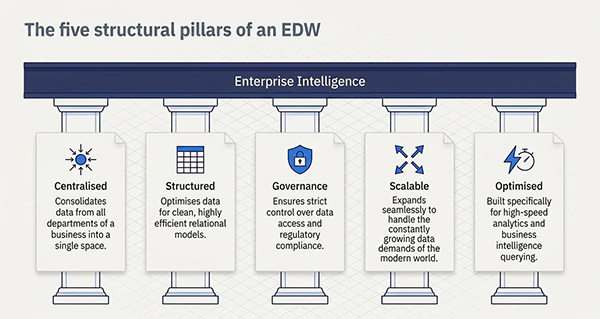
An enterprise data warehouse provides a comprehensive and consistent view of data present in a company. It has the following characteristics.
- Centralized – Covers data from all departments of a business.
- Structured – Data can be optimized for clean relational models.
- Governance – Control over access and compliance with the data.
- Scalable – Can easily handle growing data demand in today’s world.
- Optimized for Query – Yes, this is built specifically for analytics and business intelligence.
Enterprise Data Warehouse Architecture
The technical architecture of an EDW warehouse includes many components. In this section, I will write about systems and components that work together to manage and process it efficiently.
Let’s have a look.
1. Data Sources
This points to the origin, such as CRM, ERP, various apps, IoT devices, files, and operational databases that generate raw data.
2. Ingestion and ETL/ELT
Data is ingested into the system, and then the pipelines (ETL or ELT) are responsible for the movement and transformation of the ingested data. It involves extracting and transforming it into a consistent format.
3. Staging Area
Before the data is loaded into the warehouse, it is parked in the staging area. It acts kind of like a temporary workspace that is used to clean, validate, and format raw data before the data ingestion process begins.
4. Storage Layer
Central databases optimized for analytical (OLAP) processing often use columnar storage and dimensional modeling.
5. Metadata Repository
This is a system where a catalog is created, responsible for storing data lineage, relationships, schema descriptions, and more. These are crucial attributes responsible for understanding and managing it effectively.
6. Presentation Layer
On top of all that sits a presentation layer responsible for Business Intelligence (BI) tools, dashboards, and reporting interfaces. It allows users to access, query, analyze, and visualize data stored in the EDW database.
Benefits of Implementing an EDW
A company has a number of significant advantages when they have access to an EDW data warehouse.
Let’s check them out for ourselves.
- An enterprise data warehouse offers additional support for data, where it can track, manage, and analyze information for more actionable insights.
- Because it combines information from all departments in a company, there are no more data silos. It acts as a single source of truth in a central space.
- EDW easily works with other analytics programs and promotes company growth.
- They provide clear context and relationships between individual points. It means you can easily understand the information and its meaning.
- It has the capability to identify and resolve errors, duplicate entries, and missing fields. That can improve the overall data quality.
- Also, it can store as much data as needed without practical limits on volume.
Implementing an Enterprise Data Warehouse
There are several software providers offering enterprise data warehouse services. However, not every piece of software is built for everything under the sun.
Building your own enterprise data warehouse software could be the perfect bet for a company, as it can fit perfectly with your existing systems and processes. Some people might wonder if it can be a daunting task. But it’s not.
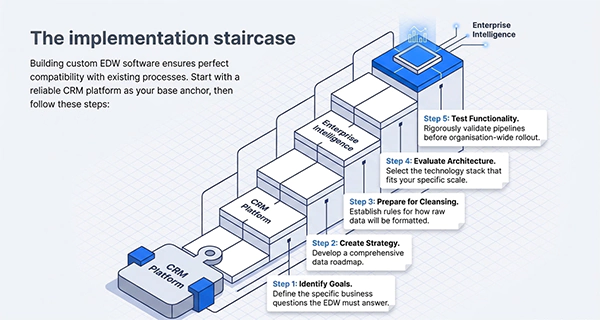
Start with a reliable CRM platform and then build your software around it. You can easily design a working warehouse compatible with your organization. Another thing is that it will be on par with what the market is offering right now.
Understanding the needs of your business is of utmost importance before implementing an EDW warehouse. So, before settling on a solution, you must do your own research to build one.
For that, you need to:
- Identify your goals
- Create a data strategy and roadmap
- Cleanse and prepare the data
- Evaluate EDW architecture and technology
- Test functionality
EDW vs. Data Mart vs. Operational Database
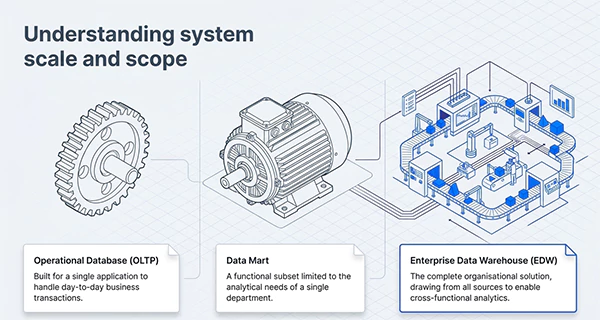
People often get confused among these three terms. So, let’s look at the difference.
- Operational Database – The operational database (OLTP system) is built for handling day-to-day transactions of a business app. So, things like order processing, user account management, and inventory updates come in this category.
- Enterprise Data Warehouse – Think of it as the enterprise analytics solution. It gets data from all sources within the organization and then formats it in a way that allows complex queries.
- Data Mart – It is a subset of a data warehouse and is limited to a single department of a business.
Let’s look at the key difference between these three.
| Characteristic | Operational database (OLTP) | Data mart | Enterprise data warehouse (EDW) |
| Scope | Single application | Single department | Entire organization |
| Data sources | Application itself | One or few sources | Many sources across the business |
| Optimized for | Transactional reads/writes | Departmental analytics | Cross-functional analytics |
| Schema design | Normalized (3NF) | Star or snowflake schema | Star, snowflake, or normalized depending on approach |
| Data history | Only current state | Some history | Full record |
| Users | Application end users | Department analysts | Analysts, executives, data scientists across the org |
| Size | High (up to TBs) | Low | Highest (even in PBs) |
Also read: Data Lake vs Data Warehouse
Conclusion
Bringing the data together from each department of an organization will make EDW a trusted and secure repository created specifically for reporting and analysis.
It addresses common challenges, such as silos, inconsistent reports, and unreliable data. All these capabilities make EDW the core foundation for enterprise data analytics that relies on trusted information.
In addition, it can also improve quality, strengthen enterprise analytics, and support advanced capabilities including ML.
For a business, EDW can be a great asset that helps organize the data and turn it into valuable insights.
FAQs
What does EDW stand for?
EDW stands for Enterprise Data Warehouse. It is a central system that brings together data from all departments of a business.
Can enterprise data warehouses handle big data?
Yes, they are specially designed for that purpose.
What is the difference between EDW and DM?
EDW is a central system that is used specifically for large data and enterprise-wide analytics. A data mart is a smaller subset designed specifically for departmental use.
What are the benefits of EDW?
The benefits of EDW include improved and faster decision-making, consistency in data, enhanced data quality, and reduced time for report generation.
Sources:
- Data Warehousing Concepts – Oracle