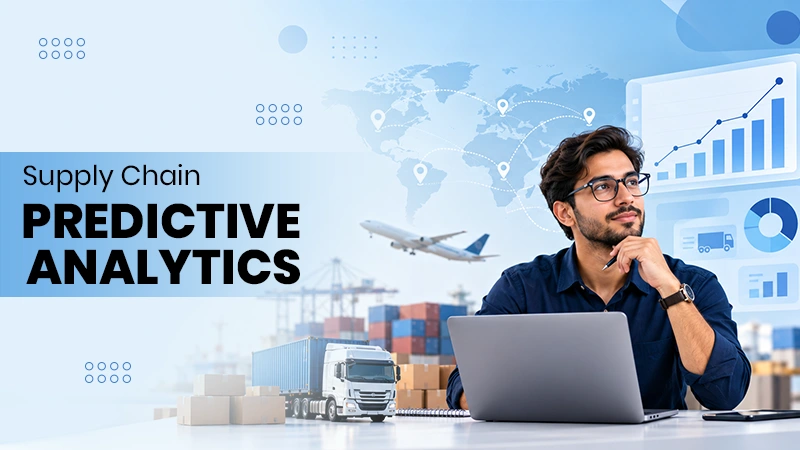
A Detailed Guide to Understanding Supply Chain Predictive Analytics
For any operating executive, predictive analytics in supply chain is no longer a specific differentiator of its own. The majority of competitors have access to comparable forecasting, as the advantage is no longer restricted to this layer. The benefit has moved a little downwards and focuses on the speed and coordination through which a simple prediction becomes action.
Here, we aim to tell you everything about supply chain predictive analytics and how its correct operation can turn you into a leader in the field. You will learn how predictive analytics in the field of supply chain transforms raw data into simple foresight, thus allowing leaders to shift from reactive problem-solving to proactive planning.
- A strategic shift from reactive to proactive
- Cases across the supply chain
- Advanced supply chain forecasting techniques
- Exploring the role of integrated systems
- Challenges and considerations in supply chain predictive analytics
- The executive model – Leading with data
- Applications of supply chain predictive analytics across industries
- FAQs
A strategic shift from reactive to proactive
Supply chain data analytics have historically operated in a reactive mode by addressing issues as they emerge, which is often too late to minimize damage. The use of predictive analytics shifts this model entirely by using historical data, real-time inputs, and advanced algorithms to predict and forecast potential errors and issues before they can even occur.
This shift empowers leaders to move from simply reacting to prevention. Whether you are identifying early supplier risks or anticipating a change in customer demand, predictive analytics in the supply chain ensures that you have a better vision of what lies ahead for insightful decision-making.
Predictive analytics is most effective when integrated with different data sources across the value chain, procurement, logistics, and supplier and customer behaviour. This allows businesses a complete view of all operations, giving way to real-time decision-making and the ability to adjust as issues arise.
Agility is another important concept that not only refers to basic speed, but is also the ability of businesses to act quickly and decisively when faced with serious issues. Predictive tools assist companies in different scenarios and allow them to choose the correct response for multiple issues. The result is a supply chain that can not only handle shocks but is also capable of adapting and improving through them.
Cases across the supply chain
Predictive analytics is making real waves in different parts of the business. Retailers and manufacturers rely on AI to guess what customers will buy, so they don’t end up with too much or too little inventory. On the supply side, predictive models help spot which vendors are likely to run into trouble, whether it’s compliance issues, delays, or shaky finances, so companies can jump in before it’s too late.
For inventory, businesses dig into seasonal trends, market shifts, and past numbers to keep their stock just right. And in logistics, these tools try to pinpoint weather delays, risky routes, and swings in fuel prices, so the whole operation runs smoother.
Advanced supply chain forecasting techniques
Predictive analytics for supply chain has turned into one of the most sophisticated disciplines, where numerous advanced techniques are used by companies to make actionable and precise predictions. Take a look at some of the key methods that are used to redefine the way businesses forecast.
Machine learning models
Machine learning, also known as ML, is perfect for uncovering patterns in huge datasets. Imagine that a simple regression model can only analyse current and seasonal sales trends, whereas a more advanced ML network can even identify the hidden relationships in supply chain behaviour.
Many organizations take this process a step further by applying natural language processing, as this can even analyse news headlines and social media trends to predict the shift in demand.
Probabilistic forecasting
Instead of simply predicting one outcome, a probabilistic model presents a number of different possibilities. The Bayesian model has refined the way forecasts happen, as it uses new data as soon as it becomes available. This offers a more adaptable approach to businesses in uncertain situations.
Additionally, the Monte Carlo simulations assist businesses in creating multiple scenarios, such as a sudden demand spike or supplier delays. This provides teams with a better understanding of what might happen so that they can plan accordingly.
Hybrid forecasting systems
It is quite evident that a single model cannot fit every scenario, and this is the place where hybrid systems showcase what they can do. With the perfect combination of traditional forecasting methods with machine learning and probabilistic approaches, businesses can easily gain a complete and more comprehensive view of potential outcomes.
For example, a retailer can use a hybrid system to predict both short-term demand and long-term stock needs, which ensures flexibility across all timeframes.
Exploring the role of integrated systems
It is also important to understand that you cannot drop predictive analytics into the business and expect miracles. Supply chain data analytics works best when it’s plugged into a bigger system. Think cloud-based ERPs, real-time dashboards, machine learning, IoT sensors: the whole setup. When everything connects, the supply chain basically gets an intelligent upgrade.
Challenges and considerations in supply chain predictive analytics
Adopting predictive analytics does not come without challenges. Companies can face common hurdles, such as data quality and seamless integration across systems. There is also a risk of over-reliance on models without any form of human oversight. To navigate these challenges and issues, organizations should direct their focus towards:
- Ensuring clean and consistent data streams
- Starting the process with high-impact use cases
- Embedding analytics into business processes and not simply IT systems
- Keeping humans in the process to interpret and act on insight
The executive model – Leading with data
For executives, the big picture isn’t just about grabbing the latest tech. It’s about rethinking how the company works: from buying supplies to running operations, managing money, and serving customers. Predictive analytics is a piece of a larger puzzle to modernize the business.
C-level leaders have to own this shift. They need to push for a culture that runs on data, back up their teams with the right talent and tools, and make sure the insights line up with bigger goals. It takes more than just chasing cost savings or throughput. Now, resilience means looking at how fast a company bounces back, spreads its supplier risk, and makes decisions. Predictive analytics gives answers, but it won’t mean much if leadership isn’t ready to act quickly.
Applications of supply chain predictive analytics across industries
Predictive analytics supply chain applications can be seen very visibility across numerous industries. This offers tailored solutions to unique challenges that businesses face. From high-tech to retail, this is how different sectors use supply chain predictive analytics.
Retail
It is common for retailers to face unpredictable demand caused by promotions, trends, and seasons. By correctly analyzing point-of-sale data and social media activity, retailers can adjust stock levels to meet upcoming demand. For example, a fashion retailer can see a surge in sales of specific items during the holiday season.
Manufacturing
Manufacturers also grapple with complex supplier networks. Here, predictive supply chain analytics permit them to assess supplier reliability with ease. Imagine a car manufacturer monitoring the performance of its supplier and adjusting orders to avoid costly downtime.
Healthcare and pharmaceutical
The pharmaceutical industry also benefits a lot from supply chain predictive analytics, as IoT sensors can easily track temperature-sensitive shipments. This ensures that your products, such as vaccines, remain safe during transit. Analytics also assist in demand forecasting for medications, allowing companies to avoid shortages in patient care.
Food and beverage companies
Numerous food and beverage companies also rely on analytics to manage their perishable goods that spoil easily. With the perfect combination of weather forecasts and demand data, a beverage company can prepare for the oncoming heatwave and stock their shelves without wastage.
FAQs
What is the meaning of supply chain predictive analytics?
Supply chain predictive analytics refers to the use of data and models to predict and forecast shifts in demand, supply chain, and capacity constraints before they even happen. The process gives leadership better and more reliable visibility into developing conditions, which shortens the time between a change forming in the supply chain and the moment leadership can recognise it.
Why is forecast accuracy no longer a differentiating factor?
Since the majority of competitors have access to comparable forecasting, forecast accuracy no longer works as a differentiator. Two companies with the same forecast can upload very different results. This advantage has now moved downstream from forecast accuracy to decision velocity, which is the speed at which a prediction becomes coordinated action.
How should executives evaluate the supply chain predictive analytics process?
The first thing that executives should do is focus less on forecast accuracy and more on what will happen after the forecast. This will assist in creating a faster response.