Data Governance Framework: Complete Guide with Top Tools (2026)
A data governance framework is a structured model used by businesses to manage their data assets. It includes processes, roles, strategies, and technology to keep the data accessible, secure, compliant, and aligned with business objectives. According to IBM’s 2026 Cost of a Data Breach Report, the average cost of a data breach has reached $6 million due to AI-enabled threats and poor data governance. Businesses deal with large amounts of data creation and transfer every day.
This article will cover what data governance is, its framework models, governance tools, and how to implement data governance step by step in your business.
- What is Data Governance?
- What is a Data Governance Framework?
- Data Governance Policy
- Data Governance Framework Models
- What are the Data Governance Tools?
- How to Implement Data Governance—Step-by-Step
- Data Governance for Indian Businesses—DPDP Act
- Common Challenges in Data Governance and How to Overcome Them
- Conclusion
- Frequently Asked Questions
What is Data Governance?
Data governance is the set of roles, processes, and policies to ensure data quality and usage across the organization. It ensures that data is accessible, compliant, and secure and that users can easily find, share, and use the data without the help of an IT professional. It is important to improve data accuracy, maintain consistency, avoid misuse, and help organizations to take data-driven decisions.
Now we will understand the difference between data governance, data management, data stewardship, and data quality.
Data Governance vs Data Management vs Data Stewardship vs Data Quality
Data management and data governance are often considered the same but are two different entities. While governance is focused on the rules and processes for data accuracy and accessibility, data management means managing the data lifecycle from start to finish, which includes storage, integration, data transfer, and system maintenance.
Data stewardship focuses on real-time execution of the policies made under the framework, and data quality determines the fitness, relevance, and completeness of data.
Take a look at the difference between data governance, data management, data stewardship, and data quality.
|
|
|
|
|
|
|
|
What is a Data Governance Framework?
A data governance framework is a set of structured policies, rules, and responsibilities that determine how data is managed, used, and accessed in an organization. It helps the organizations to remove silos, build trust for accurate reports, and reduces legal risks by structured auditing controls.
Key Components of Data Governance Framework
The components of a data governance framework are determined by the organization’s business goals, such as metadata management and data lineage. Its structure and data expertise. Key components of the framework include quality management and data stewardship.
- Data Quality Management. The framework drives quality by assigning the quality assurance responsibility to data owners and data stewards.
- Technology Metrics: Metrics that track accuracy lead to finding the loopholes in the framework and figuring out where the validation rules must be changed in the framework. Metadata and catalogue metrics track the percentage of documented data and drive the compulsory inclusion of ownership assignments.
- Data Compliance and Protection: Access control scoring for roles and how they can use it. Encryption helps in the safe movement of data between the systems, and audit tracks the access changes
- Governance Policies: a set of approved guidelines for roles and responsibilities that determine the outcomes to influence data.
- Data Stewardship: People are made owners of financial data who monitor data quality and consistency, update definitions of business terms, and find and acknowledge data issues.
Also read: What is Market Analysis? A Complete Step-by-Step Guide to Doing a Market Assessment
Data Governance Policy
A data governance policy is a structured framework that includes rules and responsibilities designed to manage, process, and utilize data. It includes processes, technologies, and models that drive the organization’s data system. It defines who can access what data and what the owners’ roles are as stewards. Policies reduce the risk of data breaches by making structured guidelines which can comply with the regulations.
Due to clear and rigid policies, it reduces repetitive manual effort and waste of resources and builds AI readiness by improving data quality for training large language models. It also makes the organization stand out in the competitive market due to reliable data and fast-paced decisions.
Take a look at the difference between the data pokcy, data framework and data program.
| Data Policy | Data Framework | Data Program |
|
|
|
|
|
|
|
|
|
Data Governance Framework Models
Data framework models depend on how they maintain data architecture, govern data, and do operational management. And how they align with the business strategies to make data-driven decisions.
Based on these pillars, some of the data framework models are:
1. DAMA-DMBOK
The Data Management Body of Knowledge (managed by the Data Management Association) is a framework that provides principles, policies, and functions to govern, manage, and scale data programs.
There are 11 DMBOK knowledge areas (DAMA Wheel), and the core area is data governance. Other areas are architecture, modelling and design, storage and operations, security, integration and interoperability, document and content management, reference and master data, data warehousing and business intelligence, and metadata and data quality.
| Key Features |
|
| Complexity |
|
| Cost to Implement |
|
2. COBIT by ISACA
Control Objectives for Information and Related Technologies (COBIT) is a well-developed framework established by the Information Technology Governance Institute (ITGI) that facilitates information and enterprise management. Key COBIT principles include addressing and fulfilling the stakeholders’ needs, end-to-end enterprise coverage, and differentiation between governance and management.
| Key Features |
|
| Complexity |
|
| Cost to implement |
|
3. DGI
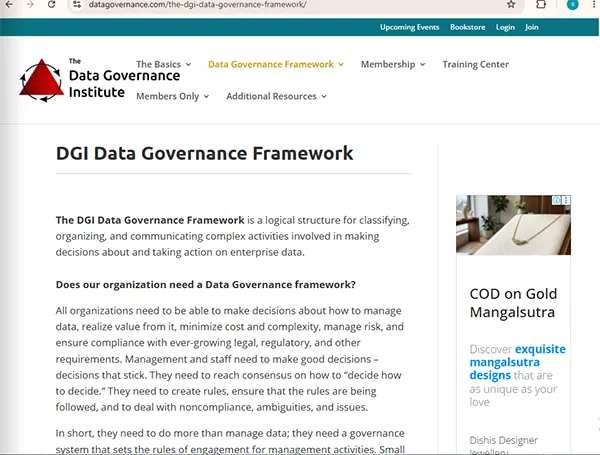
The DGI data governance framework model is a structured blueprint that helps to organize data and simplifies the complex activity of making decisions and taking action on them. It emphasizes the value statement, which means, ‘Why are we organizing data?’ and assigns roles and tasks according to the level and position of the people. The model determines the policies for how data will be shared and stored and defines the methods and steps to solve the data problems.
| Key Features |
|
| Complexity |
|
| Cost to implement |
|
4. Eckerson
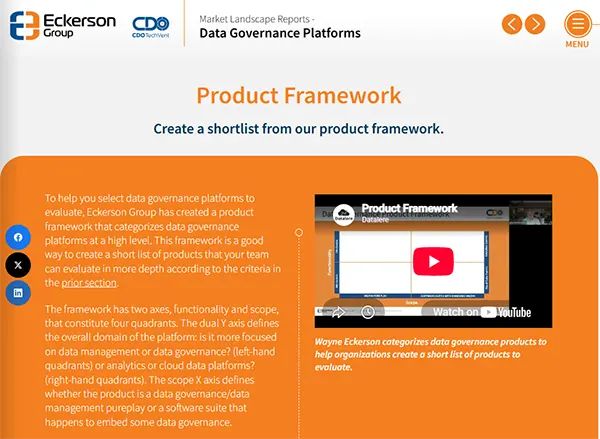
The Eckerson Data Governance Framework Model, designed by Wayne Eckerson, is a hybrid and structured blueprint that manages business data assets; instead of just forcing huge data restrictions, it focuses on improving data quality with a balance of control and freedom.
| Key Features |
|
| Complexity |
|
| Cost to Implement |
|
What are the Data Governance Tools?
Data governance tools are the solutions that are specifically designed for managing data in organizations by making searchable inventory, tracking metadata lineage, enabling controlled access, and complying with the regulations. There are several modified governance tools which help the business to streamline the data managing process. Some of the popular data governance tools are Collibra, Alation, Informatica Axon, Microsoft Purview, Atlan, and Ataccama.
Have a look at the different data governance tools with their pricing.
| Data Governance Tool | Key Features | Best for | Pricing |
|
|
|
|
|
|
|
|
|
|
|
|
|
|
|
|
| Microsoft Purview |
|
|
|
Also read: Top 18 Data Analysis Tools in 2026 (Traditional and LLM-Based Tools Covered)
How to Implement Data Governance—Step-by-Step
Step-by-step implementation of data governance is necessary to frame a digitally accessible, manageable roadmap to streamline business operations. Implementation helps in making a structured blueprint to prevent confusion and disruptions, leading to keeping all the important aspects at one place. Data governance implementation involves defining data purpose, assigning roles and responsibilities, establishing policies, and using governance tools.
Below are the steps to implement data governance in yourr business in an effective way.
1. Define the Governance Purpose
Analyze the purpose of a data governance initiative, such as what the pain points are: Delayed reports, broken emails, disrupted data accessibility, weak communication, language barriers, compliance violations, data silos, or other operational difficulties.
2. Structure a Governance Framework
Considering the advice of the organization’s IT experts, stakeholders, and workers, the legal compliance team designs the policies, rules, and guidelines that govern data management and processes.
3. Assigning Roles and Responsibilities
Assign positions like chief data officer for overall vision and aligning the framework with business goals. Data stewards for writing definitions, managing quality, and access rights; data custodians for protecting data storage and security controls.
4. Define Policies
Structure all rules and guidelines to be followed for the framework, like data privacy policies who can access what data), data retention standards time limit of keeping data), business glossary (business term definitions for common vocabulary), etc.
5 Tools and Technology Metrics application
Choose the right software tools to automate the framework, which includes a catalogue, metadata management, lineage tools, data quality management tools, and access management tools. All these features can be available in a single platform, or you can use different tools for specialized areas.
6. Training Stakeholders
The designed roles and policies should be understood by the stakeholders, data stewards, and custodians so that they can work on their responsibilities in an effective way. Train leaders about their regulatory compliance rules and stewards about ownership and quality standards. Employees should be trained about privacy rules and company policies.
7. Check the Framework Performance
Verify that KPIs align with your business goals or not. Use tracking tools and audits to check the progress; do small sessions and meetings with enterprise fellows to identify mistakes, update the rules, change roles, etc.
Data Governance for Indian Businesses—DPDP Act
The Digital Personal Data Protection (DPDP) Act is India’s first rights-based primary framework that defines the law for companies on how to collect, process, store, and use personal data of individuals to protect their privacy. The Act includes four mandatory rules for companies to follow:
- Granular Consent: They must obtain consent before collecting users’ data.
- Purpose Limitation: The data can be used for a specific reason or purpose.
- Data Minimization: Only use data that is needed for a specific service.
- Erasure Right: Erasing the data from the database once the user deletes the account.
The RBI and SEBI act as strict financial watchdogs. While the DPDP privacy law generally lets standard businesses store data outside the country, these two regulators completely block financial data from leaving India to protect national security. Specifically, the RBI mandates that all payment logs and card details must live on physical servers inside India, while SEBI forces all stock trading and investment data to stay strictly within local Indian cloud systems.
Also read: 10 Best Data Visualization Techniques With Its Types, Usages, and Examples
Common Challenges in Data Governance and How to Overcome Them
Data governance is a complex task for businesses to inculcate in their operations. Implementing it brings major challenges like lack of ownership, missing goals, and poorly defined success metrics.
Take a look at the common challenges in data governance and learn how to overcome them.
1. Lack of Ownership
Departments often treat data management as someone else’s responsibility. Business units expect the IT department to fix all data quality issues. No clear individuals are held accountable for specific datasets. To overcome this, appoint dedicated business data stewards to own and maintain specific data domains.
2 Missing Goals
Businesses often try to manage every aspect of governance without clearly defining the specific need, such as which data assets to monitor, whom to give access to, etc. Strategies fail to give the optimum results. To fix this, align the framework with specific outcomes.
3. Poorly Defined Success Metrics
Leaders cannot see the financial value of the project. They measure performance based on the activities done rather than the results achieved. To fix this, you should prioritize key performance indicators like report generation time, error reduction rates, etc.
4. Culture and Change Resistance
Employees see new data rules as annoying extra paperwork. Staff keep using old, unsafe habits to get work done faster. People avoid new tools because they lack training. To fix this, train staff and show them how the rules save them time.
5. Siloed Data Architecture
Different departments use separate systems that do not talk to each other. Multiple versions of the same file create massive confusion. Leaders cannot get a single, honest view of business facts. To fix this, use central data software to connect all your separate systems.
Conclusion
In this article, we studied the data governance framework, its models, and its tools. Data governance framework is a structured blueprint that helps businesses to organize, store, and access data to maintain data quality, compliance, integration, completeness, and consistency on the enterprise level.
DAMA, DMBOK, and COBIT are some of the data governance framework models used by companies to manage data. To effectively implement the framework, businesses need to define their goals, assign roles across the departments, specify the KPIs, and use the right governance tools.
Frequently Asked Questions
What is a data governance framework?
A data governance framework is a structured blueprint to store, secure, and access data across the organization, which ensures data quality and data compliance.
What is the difference between data management and data governance?
Data management focuses on the operational handling of data, while data governance focuses on creating policies and models to make it secure, accessible, and compliant.
What are some of the standard data governance framework models used across industries?
Some standard data governance framework models are DAMA, DMBOK, DGI, and COBIT.
Who is a data steward?
A data steward is the professional in the company who is responsible for establishing data quality, making business definitions, and solving data conflicts in the organizational departments.
Which regulatory standards must the data governance framework follow?
A data governance framework must follow worldwide privacy laws like GDPR, CCPA/CPRA, the DPDP Act, and specifically the EU AI Act for digital standards.
Sources:
- Cost of Data Breach Report 2026: IBM