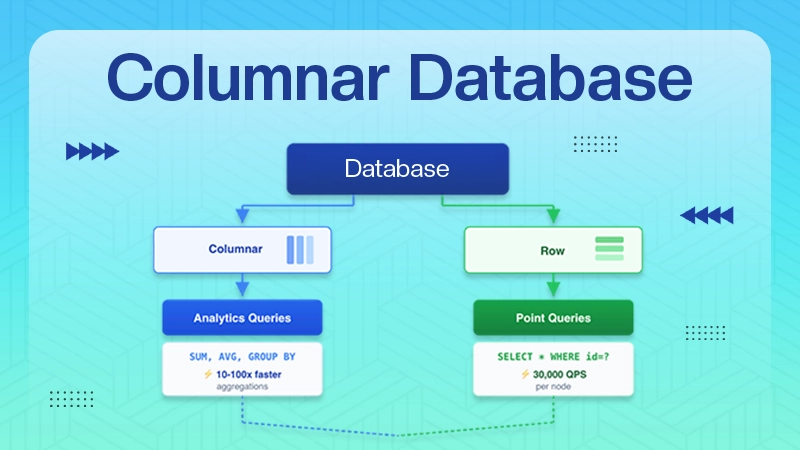
What is a Star Schema? Definition, Components, Benefits & Star vs Snowflake Schema
Data warehouses are designed in a way so they can store large quantities from various sources. But mere collection will not suffice if the resources are not organized and cannot be found when they are required.
That is where the star schema comes in.
It is an easy-to-understand data modeling technique known for its speed and simplicity. With this, one can easily retrieve the data, enhance query performance, and support business intelligence.
By the end of this guide, you’ll learn the fundamentals, key components, benefits, limitations, real-world examples, and more. We’ll also cover its comparison with the snowflake schema.
Let’s unpack this topic step by step.
What is a Star Schema?
A star schema is a widely used data modeling technique used in data warehousing and business intelligence. It is set up in a way that makes it best for querying rather than updating.
It is called the star schema due to its visual resemblance to a star. At the center, there is a fact table that holds numerical values, and on the outer edges are dimension tables that provide descriptive context.
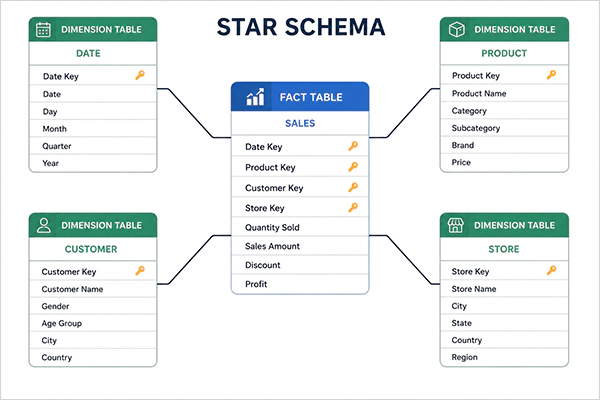
As you can see from the above image, the star schema data model keeps it simple.
Components of a Star Schema
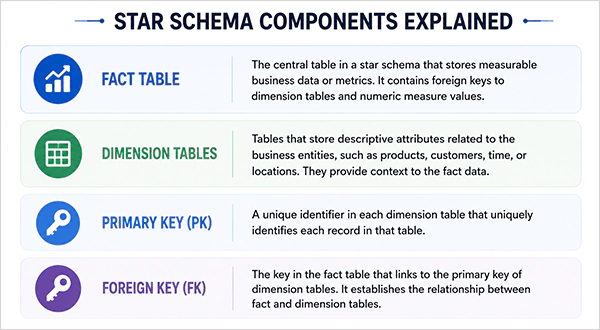
The star-schema data model only has a few core components that are necessary for efficient querying.
Main components: Fact Table, Dimension Table, and Primary & Foreign Keys.
1. Fact Table
At the center of the star schema lies a table, called the fact table, that contains data reflecting business performance.
Measurable values and foreign keys are found in the dimension tables.
Measurable values in a fact table can include the following things.
- Revenue
- Sales amount
- Profit
- Cost
- Number of transactions
- Quantity sold
and more.
A fact table has many rows but fewer columns. Have a look at its example.
Example of Fact Table:
| Sale ID | Product ID | Customer ID | Date ID | Store ID | Sales Amount |
| 1001 | P101 | C201 | D001 | S11 | $850 |
| 1002 | P204 | C175 | D001 | S15 | $1,120 |
| … | … | … | … | … | … |
2. Dimension Tables
Each node of the star schema is called a dimension table. These nodes (dimension tables) store descriptive information that provides context to the data available in the fact table.
Attributes in these tables filter and categorize the data. This supports analytical reporting and decision-making.
Every dimension table in a star database schema has a primary key linked to the foreign key of the fact table.
Example of Dimension Table: (Product Dimension)
| Product ID | Product Name | Category | Brand |
| P101 | Laptop | Electronics | Lenovo |
3. Primary and Foreign Keys
For those who are not aware, keys are a set of attributes in a table to create a connection between two tables.
In the case of a star schema, primary and foreign keys are used to interlink the two tables: Fact and Dimension.
Primary Key – It is a column in a table that uniquely identifies each row. Every dimension table must include a primary key.
Foreign Key – In contrast, a foreign key is a column in the fact table linking to the primary key of the dimension table.
What are the Benefits of a Star Schema?
The use of the star schema model for data warehousing has many benefits. With this, data management becomes easier, and the company can make business decisions based on conclusions from the data.
Let’s check out some of the benefits of utilizing a star schema in data warehousing.
- Enhanced Analysis – A star schema makes it easy to analyze large datasets without any complications. For example, complex queries that involve multiple dimensions and measures will now be much simpler and faster.
- Data Retrieval – The denormalized layout of dimension tables significantly decreases the number of table joins for data extraction.
- User-Friendly – Facts and descriptive context are two different things. So, that makes it easy for non-technical users to understand.
- OLAP Compatibility – It perfectly mirrors the logic used by modern Business Intelligence (BI) platforms and Online Analytical Processing (OLAP) systems.
Limitations of a Star Schema
We’ve seen many things here in this article that will make you think that a star schema is all you need.
However, a star schema may not be suitable for all use cases. That means, if you understand the star schema limitations, you can choose the right one.
- Data Redundancy – The denormalized nature of dimension tables inherently makes them store redundant data.
- Higher Storage Requirements – Since there are redundant entries in this, the storage requirements for a star schema are high.
- Less Suitable for Transactional Systems – It is suitable for analytics and not for frequent processing.
How to Implement a Star Schema?
Here are the steps a business needs to implement a star schema.
- First, identify the business requirements and determine the required key metrics.
- Now, define the fact table attributes.
- After that, assess the relationship between data metrics from dimension tables and check how they need to be used.
- Include the relevant attributes from the dimension tables in the fact table.
- All that is left is sourcing the data from various sources to load into the respective tables.
Star Schema vs. Snowflake Schema: Key Differences
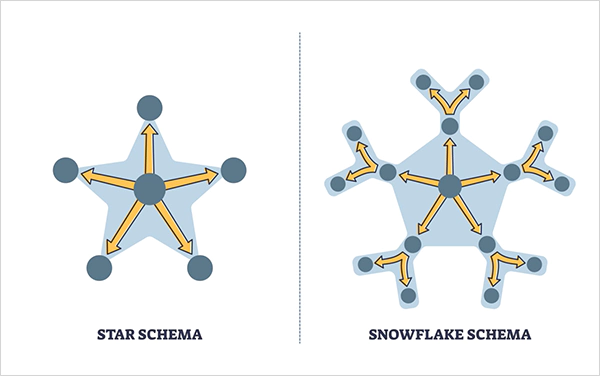
In the world of data warehousing, there are two dominant data models – Star Schema and Snowflake Schema.
The key difference between the star schema and snowflake schema is how they handle normalization within dimension tables.
The choice between these two will ultimately depend on the strategic decision of a business.
Let’s look at the key difference between these two.
Core Structure
- Star Schema Layout – A central fact table is directly linked to flat dimension tables. That is why it forms the star shape.
- Snowflake Schema Layout – The central fact table is linked to dimension tables, but the dimension tables branch off into secondary lookup tables.
Key Comparison
| Architectural Aspect | Star Schema | Snowflake Schema |
| Normalization | Denormalized | Normalized |
| Data Redundancy | High | Low |
| Query Speed | Faster | Slower |
| Storage Footprint | Higher | Lower |
| Data Maintenance | Harder to update | Easier to update |
| ETL Complexity | Simple data loading pipelines | Intricate, multi-stage loading rules |
| User Navigation | Businesses can easily query | Complex to navigate without a semantic layer |
Wrap Up
A star schema remains one of the most popular, reliable, and effective data modeling techniques used in data warehousing. Its simple, intuitive structure, built around a fact table, makes it easier to understand, maintain, and query.
A star schema might excel in performance and ease of use; however, it can not be used for every use case. If a business has highly complex datasets, it may want to go for advanced data models.
Ultimately, choosing the right data model for a business will completely depend on organizational needs.
FAQs
What is a star schema?
A star schema is a widely used data modeling technique used in data warehousing and business intelligence. The data is organized in a central fact table surrounded by dimension tables.
Why is it called a star schema?
Because its layout matches perfectly with what a star looks like. In this arrangement, the fact table acts as the center point, and dimension tables are linked like a node in a star.
What is the difference between a star schema and a snowflake schema?
A star schema uses denormalized dimension tables, while a snowflake schema uses normalized dimension tables.
Where is a star schema used?
A star schema is used in things such as business intelligence, data warehousing, sales reporting, financial analysis, healthcare analytics, retail, and supply chain management.