What is Market Analysis? A Complete Step-by-Step Guide to Doing a Market Assessment
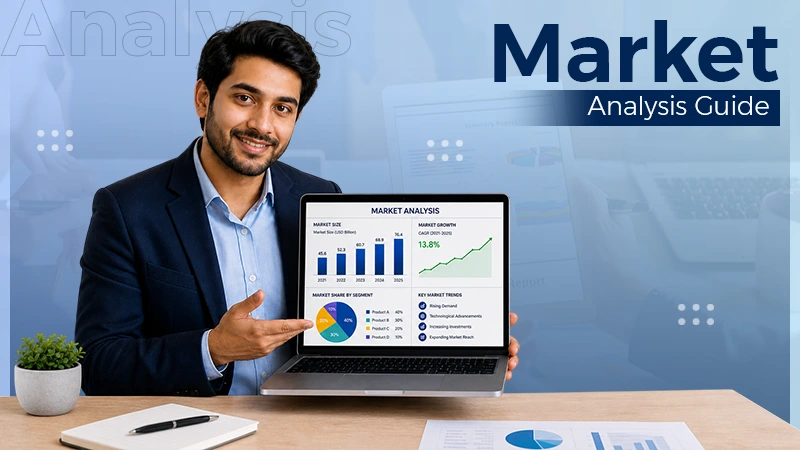
Are you planning to start your own business and confused about how to research the market? Well, the foremost step before starting a new business is to do a market assessment. Market analysis is a core factor in your business that helps you understand the scope of your products and services, competitors’ strategies, available opportunities, future goals, and several market trends before entering the business market.
In this detailed article, we will discuss the importance of market analysis and various ways to do it so that you can apply them in the real world to gain exposure to the business market.
What is Market Analysis, and What Is Its Importance?

Market analysis is a detailed process of analyzing your target market before entering the business world with your products and services. It involves assessing your target audience (to understand their needs, pricing capacity, and demographics), gathering data and insights about your desired business, and doing competitor analysis.
Making market analysis efforts is helpful for new entrepreneurs who want to build their brand in these ways:
- Getting to know about the niche: conducting market analysis helps you to know about the current trends, opportunities, and insights about the business you are thinking of starting. It also helps to understand how the market runs and operates for that specific sector. For example, if a business owner wants to start a health-related brand, he must know how to comply with the guidelines provided by various regulatory bodies like WHO (World Health Organization) and the U.S. Department of Health and Human Services (HHS), etc.
- Target audience: When you start a business, directing your efforts and advertising your products towards the right customers makes sense. Market assessment helps you understand your customers’ needs and wants and how you should customize your new launches to attract and gain their attention.
- To make result-driven plans: Market analysis is a complex task to do. Understanding business insights helps to take quick decisions at the time of need when you have all the required information needed to move forward with your goals.
- Identifies your strengths and weaknesses: when you get to know where you stand out among others, you realize your biggest strengths and weaknesses. Maybe you want a joint venture for your new startup, as you don’t have enough capital to start on your own. On the other hand, it might be possible that your product has a unique selling proposition, which makes it the best-selling item in your business.
- To give your business a new direction: many times we see a shift in the industry due to the advancement of technology or changes in the share/stock market. With these changes, companies need to evolve. And change their business plans accordingly. Market assessment not only gives you new opportunities but also gives you new ways to make the transition toward a new goal.
Note: Official portals such as the U.S. Census Bureau and the Small Business Administration are two widely known market analysis portals that give real market insights and help in assessing the business market.
Steps to Do Market Analysis
Successful market research is done with complete focus and in the right way. Sidelining a single step may hamper your business goals. Here are some steps to do the correct analysis of the market:
Step 1: Decide Your Business Industry and Sector

Before jumping into the assessment, decide your business sector and industry in which you want to put your best foot forward. There are various sectors of businesses, such as:
- Financial sector
- Technology sector
- Healthcare sector
- Retail sector
- Education sector
- Agricultural culture
- Food and beverage sector
- Manufacturing sector
- Entertainment sector
Indexing your sector will help you to drive your efforts and actions in the particular field and will shape your mind to work in that direction.
Step 2: Choose Your Target Market

Once you are done deciding your business industry and its type. It’s time to focus on the customers you want to reach. First, make a list of your products and services and ask yourself a few questions.
- Which customer base would be the best for my brand?
- What should be the age group of the people to whom I would sell my product?
- At what location should the brand focus to market its new launches?
- What are the customers’ expectations from the product?
- What is the purchasing power of my target audience?
Choose your preferences that align best with your company goals and requirements, and collect data about your target audience using surveys, online polls, and feedback via both offline and digital mediums.
Step 3: Go for the Market Assessment and Trends

This is the most crucial step when doing a market assessment. Let’s take an example: if an entrepreneur thinks about opening a business that sells CDs and tape recorders, then it might not benefit him in today’s highly advanced technological world, where CDs have been replaced by pen drives and tape recorders are used very little by people.
Market assessment will help you to know what’s trending and making buzz in the business world. You can research the market using various tools and official portals given below:
| Market Research Tool | Used for |
| Google Trends | Tells which topic is trending and what people are searching for. |
| GWI (global consumer research platform) | Helps to understand the target audience and their interests and the overall interests of customers |
| Statista | Provides detailed information about various topics related to markets, companies, and their forecasts |
| Discuss (AI-powered) | Provides qualitative research using AI about the market by summarizing interviews and group discussions |
| Buzzsumo | Content marketing tool (helps in content discovery, exploring growth opportunities) |
Other than these, there are various portals, tools, and apps that you can get on the internet either free or free of cost. You can choose any of them according to your business needs.
Step 4: Keep a Check on the Competitors

To ace it in the business world, you also need to be quick and smart, and you should know what your competitors are doing.
- Analyze their marketing strategies, product positioning, sales growth, and marketing value.
- Do a detailed SWOT analysis and identify their biggest USPs and drawbacks to prepare a plan for your own products that can make you stand out in front of your target audience.
- Know what the brand offers and its pricing range.
- Know its target audience and customer reviews
Note: Always try to be better than your competitors. Don’t copy their unique ideas or steal their confidential information, which is unethical. Otherwise, you may have to face major consequences for violating the company policies.
Step 5: Understand Your Business Strengths

Once done with all the research about the competition, target audience, and the market. You need to take a closer look at yourself and your business.
- Check whether the current market trends align with your business goals.
- Do you have enough capital to start a new venture?
- Do you have enough resources (an office or a designated place of work, a skilled team, business partners to work with you, and enough time to focus completely on your business)
- Will your business solutions help in solving people’s problems?
- Will your new startup be a long-term investment?
- Is your business venture a sustainable fit for society?
If you get positive answers to the above-mentioned questions, then you are ready to go for starting a business.
All the above-mentioned steps will keep all the facts, figures, and challenges about the market in front of you. Considering all these points, you can come to a better conclusion about which way you should proceed with your business.
Benefits of Doing Market Analysis
A successful market analysis gives you a range of different benefits that you can get once you apply all the notable changes that you have measured while doing the market analysis. Some of the benefits of doing a market analysis are
- Selection of Products and Services: Once you have complete market knowledge, you can launch your new products and services according to the audience and customers’ wants and needs. You can modify your products and services according to the market trends in the future.
- Budget Management: Market analysis helps you to know what the overall cost of using all the resources in your company will be. If you have the complete details about the expenses, then you will be able to manage the budget and finances of your company accordingly and can save unnecessary waste of money.
- Exploration of new opportunities: Analyzing businesses frequently helps to discover new growth opportunities for business. For example, if a new company enters the market whose goals align with yours, then you can have a merger with that company for the successful expansion of your business.
- Increases the scope of improvement: When you have the whole market insights handy, you can make more result-driven decisions, which stops you from making mistakes, increases efficiency and output, and boosts your confidence to move ahead.
- Build your reputation as a brand: A company that does market analysis knows what is right and ethical to do in business. Being ethical and moral provides the company with credibility, which makes other brands and its consumers trust it.
- Customer Satisfaction: Carefully planned and well-researched campaigns, after doing a lot of assessment, increase the chances of making a campaign successful with good customer reviews and responses, which directly means your customers are satisfied with your company.
Common Mistakes to Avoid While Doing Market Analysis
Careful market analysis helps you make decisions that align well with your business goals, but you should know that market analysis is a process that should be done in a certain way to get the desired results. A single mistake while gathering data or getting insights from an illegal website can ruin your business. Here are some of the common mistakes that many entrepreneurs make while running a market analysis.
1. Unclear Goals
Collecting data is still easy, but not knowing what the end goal is that you expect from your business makes a difference. To grow your business, define your goals clearly, like:
- How much should the company’s gross profit be by the end of the year?
- Which company’s competitor analysis should be done?
What should be the annual expenditure for the company? - The audience that needs to be targeted should belong to which country/location?
2. Misleading Insights
There are various online sources and tools to gather market insights, but that doesn’t mean all of them will provide you with correct data. Sometimes, the data available on the websites is not updated, or the data differs across different sites. To get the correct data, you should:
- Check for insights only on verified portals and sites
- Should verify any company’s news on its own official website
- Cross-check false or misleading content
3. Unstructured Data
Mismanagement of data occurs when data is not properly categorized and utilized. For example, if a business owner is analyzing consumer behavior, then he should categorize the behavior column into various segments like buying patterns, pricing patterns, location, purchases per month, etc. Proper indexing and division of data help in increased efficiency and enable quick retrieval of data when needed.
4. Ignoring Future Trends
Relying only on the current trends may benefit your business at present or for a short period of time, but in the long run, you must focus on the changes and developments that might happen in the industry. For example, if you run a handloom business, then you must ensure that you are aligning with present-day technology of using power looms and automated machines as a backup option. The handloom industry continues to exist, but the rapid use of machines and technology is in vogue to get faster results. So, you should always be future-ready.
5. Too Much Reliance on Digital Data
Today, almost every business has gone digital. But relying solely on digital information doesn’t give you exposure in your business field. For better exposure, you must discover new places and meet new people, be part of various community discussions, and engage in those activities that can provide you with the necessary insights and information needed about the market.
Conclusion
Market analysis is nothing but the process of researching market trends, business insights, and competitor analysis, understanding consumer behavior, and finding the target audience, which helps you to get detailed information about the business market and helps you take result-driven actions in your business.
Conducting a careful market analysis includes relying on verified and updated data, structuring your gathered data, doing competitor analysis without violating company guidelines, and defining clear goals, which, in the end, can give you and your customers the utmost satisfaction.
FAQs
What is the best way to do market analysis?
The best way to do market analysis is to define your goals first, select the niche of your analysis, understand the target audience, do competitor analysis, and collect factual and field data about the market. Lastly, implement all the research and analysis in your business to achieve the desired results.
What is the difference between market analysis and business analysis?
Market analysis is the process of researching the niche, sector, trends, and the target audience associated with the market. While business analysis means analyzing the particular company or organization, its work policies, growth, marketing strategies, and overall performance.
What if your business fails despite doing market analysis?
It should be clear that market analysis doesn’t guarantee the success of your business. If you fail in your business, then you should improve your market analysis techniques. Before researching the market, you should define your market goals, plan your research accordingly, and make results-driven decisions.