
10 Best Cloud Data Warehouse Solutions in 2026: Platforms and Features
Data warehouses have become the backbone for modern business for companies collecting information from multiple sources, allowing them to connect the dots and report for better decision-making. These enterprise solutions store current and historical data in a single place so they can provide long-range business intelligence.
If you are a business looking for data warehouse solutions, there is no shortage of options, with plentiful competing service providers offering different sets of features.
This article will list the best cloud data warehouse solutions in 2026 and explain the features that differentiate them.
10 Best Data Warehouse Platforms in 2026
Below, we are listing a brand-neutral overview of the best data warehouse platforms in 2026. Let’s hit the ground running and check them out.
1. Snowflake
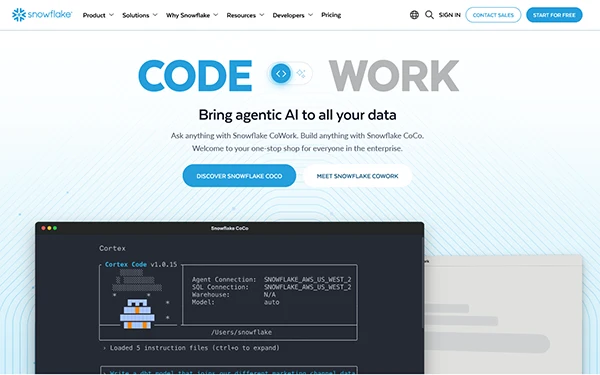
Snowflake is the real deal for anyone who wants a different cloud service provider for data warehouse capabilities. It offers a fully managed, AI-ready platform that helps teams launch data products faster.
Businesses can explore data through built-in visualizations, worksheets, workspaces, and notebooks, and access LLMs.
Pricing: They do offer a 30-day free trial with $400 worth of free usage.
Features
- Its columnar database engine is fully capable of handling both structured and semi-structured data.
- The architecture setup of Snowflake allows users to choose compute and storage to scale separately. Meaning, user have their choice of cloud storage providers.
- It can create virtual data warehouses that run on the same data.
Pros and Cons
| Pros | Cons |
| Highly scalable | Costly |
| Multi-cloud support | May require performance tuning |
| Great AI ecosystem |
2. Google BigQuery
Google BigQuery is the autonomous data-to-AI platform that enables organizations to analyze massive datasets without lifting a finger to deploy infrastructure. The best of both worlds is that it can automatically scale compute resources on the fly and integrate closely with Google Cloud’s analytics and AI services.
Pricing: They have pay-per-query or capacity-based editions. Storage charges are separate. New customers get $300 in credit.
Features
- Offers serverless architecture
- Can easily train and deploy ML models using SQL and BigQuery ML.
- Can easily query data across Google Cloud, AWS, and Azure.
- Gemini integration for assisted SQL generation and analytics workflows.
Pros and Cons
| Pros | Cons |
| Efficient data management | Difficult UI |
| Best performance for large analytical workloads | Cost can increase |
| Strong AI and ML integration |
3. Amazon Redshift
Amazon Redshift is a fully managed cloud data warehouse that scales with your usage. As an Amazon service, it offers tight integration with Amazon S3, AWS analytics services, and machine learning capabilities. So, if you are already invested in the Amazon ecosystem, you should select Redshift as a cloud-based data warehouse provider.
Pricing: Users can select on-demand or reserved instance pricing with serverless deployment.
Features
- Execute complex queries.
- Can query Amazon S3 data without loading into the warehouse.
- It can add compute resources automatically during peak hours.
- Can accelerate frequently executed queries.
Pros and Cons
| Pros | Cons |
| Deep integration with AWS | Expensive |
| Parallel processing capabilities | UI is not good |
| Great documentation |
4. Databricks
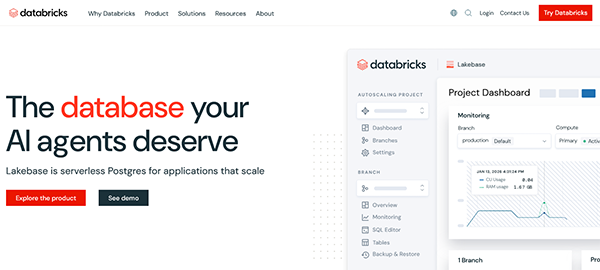
Databricks is a top-notch cloud-native analytics service built on the Databricks Lakehouse Platform and powered under the hood by the Delta Lake storage format. At the end of the day, it kills two birds with one stone by blending data warehousing and data lake capabilities in a lakehouse architecture.
Pricing: Offers consumption-based pricing depending on compute and storage.
Features
- Analyze structured and unstructured data within a single platform.
- Comes with a vectorized execution engine that enhances SQL query performance.
- Reliable data management for analytics.
- AI and ML integration
Pros and Cons
| Pros | Cons |
| Unified platform for analytics and AI | May not fare well for traditional business intelligence teams |
| Best for lakehouse workloads | Costly |
| Strong governance |
5. Microsoft Azure Synapse Analytics
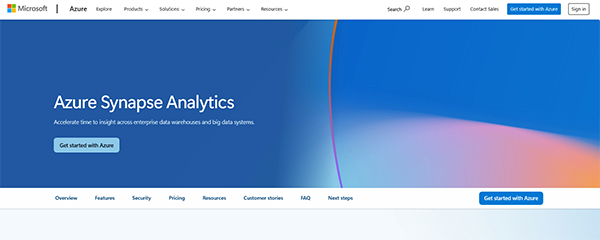
Azure Synapse Analytics is a cloud-based data warehouse service from Microsoft. It offers the best of both worlds: enterprise data warehousing and big data analytics. It enables businesses to query structured warehouse data and large-scale data lakes. At the same time, it offers close integration with the Azure ecosystem.
Pricing: Based on consumption.
Features
- Offers dedicated SQL pools
- Serverless SQL (query directly in Azure Data Lake Storage)
- Integration with Apache Spark
- Unified analytics workspace
- Integration with Azure ecosystem
Pros and Cons
| Pros | Cons |
| Strong integration with Azure services | More management required |
| Enterprise warehousing and big data analytics | Operational complexity for smaller teams |
| Flexible deployment for enterprise and hybrid environments |
6. Dremio
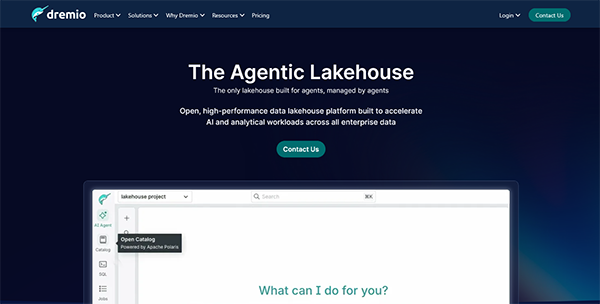
Dremio is a SQL Lakehouse platform enabling lightning-fast querying directly into data lakes. This reduces the need for heavy data movement into a warehouse. It also provides a semantic layer and strong acceleration powered under the hood by Apache Arrow.
Pricing: It has a pay-as-you-go model and starts with $0.20 per DCU for fully managed cloud.
Features
- Query directly on data lake storage
- Semantic layer
- Performance optimizations
- Supports open-source products
Pros and Cons
| Pros | Cons |
| Fast query speed | High cost for enterprise features |
| No heavy data movement | Complex setup |
| Easy BI integration | |
| Open architecture |
7. Microsoft Fabric
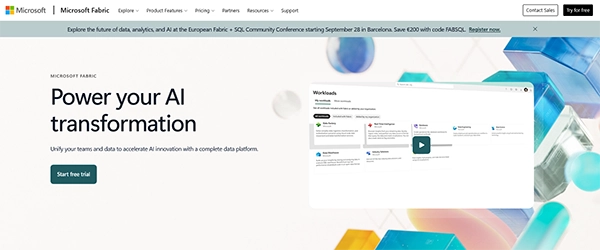
Microsoft Fabric is a game changer in the SaaS analytics world, bringing data warehousing, data engineering, and real-time intelligence together under one roof. All these things are built on a unified OneLake foundation. Unlike Azure Synapse Analytics, Fabric delivers analytics through a shared SaaS capacity model, making data management a walk in the park.
Pricing: It offers capacity-based pricing using Microsoft Fabric F-SKUs. You’d have to pay for OneLake storage separately.
Features
- This data warehouse in the cloud unifies the organizational data lake, eliminating unnecessary data duplication.
- Fabric cloud data warehousing solution enables Power BI to query delta tables directly.
- Offers a unified SaaS workspace
- Has the ability to replicate data from external platforms including Snowflake, Azure SQL, and Azure Cosmos DB.
Pros and Cons
| Pros | Cons |
| Deep integration with Power BI | Shared capacity can affect performance |
| Minimal infrastructure required | Less infrastructure-level control than Azure Synapse Analytics |
| Single capacity model across analytics |
8. IBM Db2 Warehouse
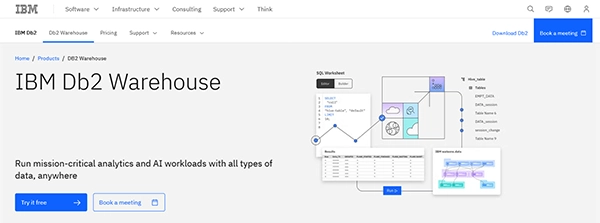
IBM Db2 Warehouse is a force to be reckoned with for businesses looking to tackle analytics and AI workloads, especially if they need governed access to data across hybrid clouds. It unifies data across IBM Db2, data lakes, and watsonx.data. It does all that without duplication and at the same time supports open data and table formats such as ORC and CSV. So, we can say that it is top-of-the-line among cloud-based data warehousing platforms.
Pricing: The pricing of IBM Db2 starts at USD $1,373 per month.
Features
- Features an in-memory columnar database engine.
- It benefits from IBM’s Netezza technology with advanced data lookup capabilities.
- It can be deployed through IBM Cloud and on-premises as well.
Pros and Cons
| Pros | Cons |
| Includes in-memory columnar database | It is expensive |
| Offers cloud deployment and on-premises options | Scantly available online resources |
| Configuration flexibility |
9. Oracle Autonomous Data Warehouse
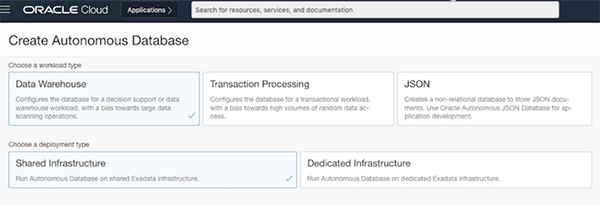
Oracle Autonomous Data Warehouse can be one of the best choices for a cloud data warehouse platform if you are already using Oracle solutions. It offers a connection onramp into the cloud, including the benefits of data warehouses, data marts, data lakes, and data lakehouses. It supports AI and analytics workloads across any cloud. Comes with built-in security, AI, governance, machine learning, and autonomous data management.
Pricing: $0.25 per unit
Features
- Works well with cloud and hardware
- Web-based notebook and reporting services share data analytics for easy collaboration.
- Strong integration with other cloud-based data warehouses.
Pros and Cons
| Pros | Cons |
| Fast query performance | Limited data connection |
| Purpose-built hardware | No on-premises |
| Support migration |
10. SAP Datasphere
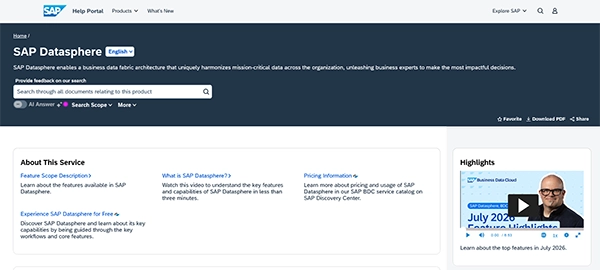
If you are an organization looking to unify, model, and share trusted business data across hybrid and multi-cloud environments, SAP Datasphere is second to none. The platform helps them connect SAP and third-party data sources, keeping business context intact by ensuring everyone is on the same page through shared semantics and metadata.
Pricing: SAP Datasphere pricing is based on core capacity. Starts with monthly capacity unit blocks.
Features
- The cloud services and database are at the core of Data Warehouse Cloud.
- Pre-built business templates can help solve common data warehouse and analytics use cases.
- Easier integration with other SAP applications.
Pros and Cons
| Pros | Cons |
| Easier inventory control | Might be slightly difficult for beginners |
| Data extraction from multiple sources | Limited visual analytics |
Benefits of Using a Modern Data Warehouse
Most organizations opt for cloud data warehouse solutions because they hit the nail on the head when it comes to business efficiency. They bring a host of benefits to the table. Have a look.
- High Performance: Most cloud computing data warehouses use columnar storage, vectorized execution, and MPP architectures to deliver fast results.
- Cost Efficiency: Businesses can easily scale compute up or down, depending on the need. So, you can avoid paying extra for unused capacity.
- Centralized Data: A single source of truth reduces fragmentation. These warehouses enforce lineage and access control policies to maintain accuracy.
- Machine Learning and AI Support: Most modern cloud-based data warehousing platforms can integrate with Python, Spark, and ML libraries.
- Collaboration: Since these are cloud data warehouses, teams can easily share governed data sets with other business units.
- Integration with Modern Data Stack: These warehouses integrate well with ETL pipelines, reverse ETL tools, data catalogs, BI platforms, observability solutions, and operational applications.
Conclusion
In this list of the 10 best cloud data warehouses, Snowflake and Google BigQuery are the best ones. They are powerful and can run everything you throw at them without breaking a sweat. However, when all is said and done, they operate behind closed doors inside their own ecosystem.
That’s not to say the rest are bad, far from it. It’s just that these two are the cream of the crop. At the end of the day, you have to choose a platform that fits your needs and budget without breaking the bank.
FAQs
What is a cloud data warehouse?
A cloud data warehouse is a central database hosted on remote cloud infrastructure that stores and analyzes large amounts of structured and semi-structured business data.
Can a cloud data warehouse replace a data lake?
It cannot fully replace a data lake. Data lakes store raw data at scale, while a warehouse stores only optimized data for analytics.
What types of data can be stored in a cloud data warehouse?
Generally, cloud data warehouses handle semi-structured formats such as JSON and Parquet. It also supports structured data.